4 millimeters equals 0.4 centimeters and approximately 0.1575 inches. Compare the specific dimension named below—diameter, width, length, or thickness. Natural objects and product sizes vary; check a ruler, caliper, or manufacturer specification before treating an example as exact.
Four millimeters sits in an interesting spot on the scale of small things. It’s too big to be invisible, but small enough that most people can’t picture it without a reference. If you hold a ruler and look at the gap between the 0 and the 4 mm mark, you’re looking at roughly the width of the tip of a standard ballpoint pen refill, roughly the diameter of a pencil eraser — except neither of those is the point of this article.
The 13 objects below each measure approximately 4 mm in a specific, relevant dimension. Where a measurement is standardized, that’s noted. Where it’s approximate or typical, that’s made clear too.
Quick Reference: 13 Things That Are 4mm
| Object | Relevant Dimension | Measurement Type |
| Dried Black Peppercorn | Diameter | Approximate (natural) |
| Standard 4mm Hex Key | Across-flats width | Exact (standardized) |
| Glass Seed Bead — Size 6/0 | Diameter | Approximate (nominal) |
| Paracord 550 | Outer diameter | Nominal |
| Standard Pop Rivet Body | Body diameter | Exact (standardized) |
| Fresh Apple Seed | Cross-width | Approximate (natural) |
| Macrame Cotton Cord | Outer diameter | Nominal |
| Flatback Rhinestone — SS16 | Diameter | Approximate (nominal) |
| Craft Pipe Cleaner Wire Core | Inner wire diameter | Approximate |
| AAA Battery Positive Terminal | Terminal height | Approximate |
| Precision Screwdriver Bit Shank | Shank diameter | Nominal |
| Smartphone Charger Cable | Outer diameter | Approximate |
| Stack of 5 Credit Cards | Combined thickness | Near-exact (standardized) |
1. Dried Black Peppercorn

A whole dried black peppercorn typically measures between 3.5 and 5 mm in diameter, with most falling right around 4 mm. This makes it one of the most accessible kitchen references for this size. You can roll one between your fingers and get an immediate sense of just how compact 4 mm really is.
The size isn’t uniform because peppercorns are a natural agricultural product, and the variety, growing region, and drying process all affect the final diameter. Tellicherry peppercorns, for instance, are intentionally left on the vine longer and tend to run slightly larger. Still, a standard grocery-store peppercorn is a reliable everyday reference for 4 mm.
2. Standard 4mm Hex Key (Allen Key)

A 4 mm hex key has a standardized across-flats measurement of exactly 4 mm. This is the actual wrench size, meaning the flat-to-flat distance across the hexagonal shaft is 4 mm. Hex keys are sized precisely because they must fit standardized socket head cap screws, and even a fraction of a millimeter of mismatch causes slipping and damage.
The 4 mm hex key is one of the most commonly used sizes in bicycle maintenance, flat-pack furniture assembly, and general machine work. If you own a set of metric Allen keys, the 4 mm one is often the third or fourth from the smallest, and its shaft gives you a perfect physical reference for the measurement.
3. Glass Seed Bead — Size 6/0

Seed beads are sized using a numbering system where a higher number means a smaller bead. A size 6/0 seed bead measures approximately 4 mm in diameter, making it one of the larger sizes in the seed bead family. These are used in jewelry making, embroidery, and textile art, and their consistent size comes from the manufacturing process used by major producers.
Because 6/0 beads are large enough to handle without magnification, they’re often recommended for beginners in beading. Their 4 mm diameter is also close enough to standardized that bead-weaving patterns treat the size as fixed, even though minor variation exists across different manufacturers and glass types.
4. Paracord 550

Paracord 550, also called 550 cord or mil-spec paracord, has a nominal outer diameter of 4 mm. The “550” refers to its minimum breaking strength of 550 pounds, not its diameter. The 4 mm thickness is a consistent feature across most commercially sold paracord of this type, which is why it’s also used as a practical size reference in crafting, survival gear, and outdoor equipment.
The cord gets its diameter from a braided nylon sheath surrounding multiple inner strands. When you hold a standard paracord bracelet or keychain lanyard, the cord running through it is typically right at 4 mm thick. It’s a firm, round cross-section that gives you a very tangible way to feel this measurement.
5. Standard Pop Rivet Body

A standard aluminum pop rivet in the 4 mm size has a body diameter of exactly 4 mm. This is a proper engineering dimension, not a rough approximation. Pop rivets are sized by their body diameter and grip range, and the 4 mm body is one of the most widely used sizes in sheet metal work, aircraft panels, automotive trim, and general fabrication.
The rivet body is the smooth cylindrical shaft that passes through the hole in the material being joined. When you look at the end of an uninstalled 4 mm pop rivet, you’re looking directly at a 4 mm circle. This makes it an unusually clean and precise physical reference compared to many organic or manufactured objects.
6. Fresh Apple Seed

A fresh apple seed typically measures between 8 and 12 mm in length, but its width across the widest point is closer to 4 mm. The seed is oval and slightly flattened, so the 4 mm dimension refers to its thickness or cross-width, not its full length. This is worth keeping in mind if you’re using it as a size reference.
Apple seed size does vary depending on the apple variety and how developed the seed is. Seeds from smaller apple varieties tend to run narrower, while those from larger cultivated varieties may push slightly past 4 mm in width. As a rough visual guide, though, splitting an apple and examining its seed gives a reasonable real-world anchor for this measurement.
7. Macrame Cotton Cord

Macrame cotton cord sold as 4 mm is labeled by its twisted or braided diameter, which is a nominal measurement. Most 4 mm macrame cord measures between 3.8 and 4.2 mm in actual cross-section, depending on how tightly it’s twisted and whether it’s a single-strand, 3-ply, or braided construction. The label reflects the intended working size.
This cord thickness is one of the most popular sizes in macrame because it’s substantial enough to show knot texture clearly but light enough for wall hangings and plant hangers. If you’ve seen macrame decor, there’s a good chance the cord was close to 4 mm. It gives the measurement a tangible, visual weight that’s easy to appreciate.
Read also: How Big Is 5mm?
8. Flatback Rhinestone — SS16

Rhinestones are sized using the “SS” system, which stands for Stone Size. An SS16 flatback rhinestone measures approximately 3.8 to 4.0 mm in diameter. This sizing comes from the original gem-cutting industry and has been carried into modern craft and fashion use. SS16 is one of the most widely available flatback sizes used in nail art, costume decoration, and apparel embellishment.
Because these stones are cut to a consistent size for setting purposes, an SS16 rhinestone is about as close to a true 4 mm circle as you’ll find in the craft world. Placed flat on a surface, it covers almost exactly a 4 mm dot. That makes it a surprisingly useful mental anchor for the measurement.
9. Craft Pipe Cleaner (Chenille Stem)
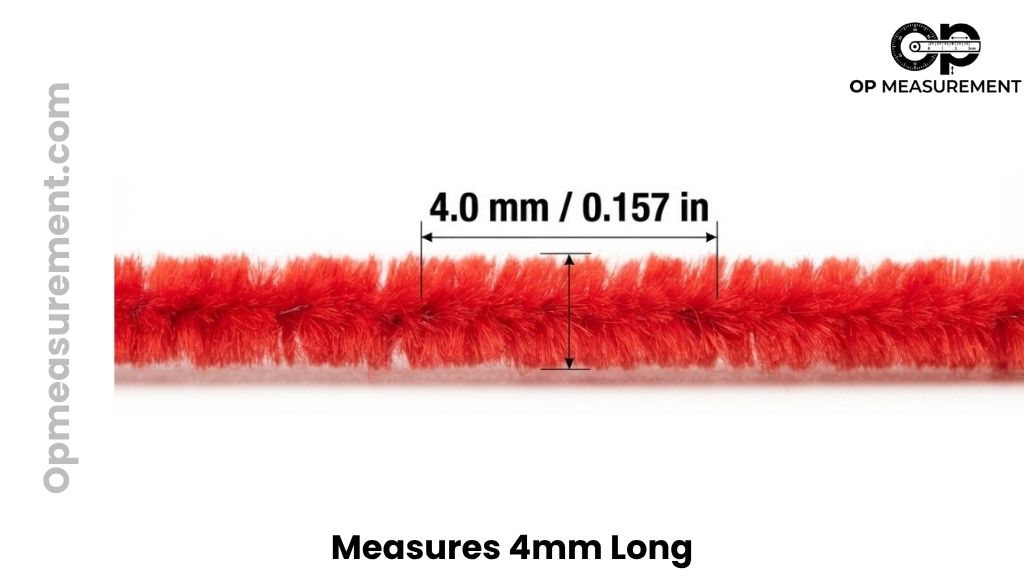
Standard craft pipe cleaners, also called chenille stems, have a total diameter of approximately 6 mm when you measure across the full fuzzy width. However, the inner wire core itself is close to 4 mm in diameter. The soft fiber wrapping adds bulk beyond the structural core, so if you’re referencing the pipe cleaner as a 4 mm object, the wire diameter is the relevant dimension.
That distinction matters for craft applications too. When pipe cleaners are threaded through beads or looped tightly, the wire core’s stiffness and diameter determine what fits and how well the structure holds shape. The 4 mm core wire is thick enough to hold its form through most basic craft applications without bending unintentionally.
10. AAA Battery Positive Terminal

The positive terminal nub on a AAA battery measures approximately 4 mm in height. This is the small raised button at the positive end of the battery that makes contact with the spring or contact plate inside a device. The terminal height is a design feature that must be consistent enough to ensure reliable electrical contact across different devices.
The overall diameter of a AAA battery is 10.5 mm, so the terminal is a much smaller feature that sits at the center of the positive end. If you stand a AAA battery on a flat surface and look at the raised nub, the distance from the flat end face to the top of the nub is close to 4 mm. It’s a specific, repeatable reference on an object almost everyone has nearby.
Read more: How Big Is 6mm?
11. Precision Screwdriver Bit Shank

Many precision screwdriver bits, particularly those used in electronics repair and eyeglass work, have a shank diameter of 4 mm. The shank is the smooth cylindrical part that inserts into the handle or driver, distinct from the working tip. A 4 mm shank is common in interchangeable-tip precision drivers sold for fine work.
This shank dimension is standardized within certain tool families so that bits are interchangeable across handles from the same manufacturer or system. If you use a precision screwdriver set for phone repairs or small electronics, there’s a reasonable chance the bit shanks are right at 4 mm. Holding one between your thumb and index finger gives an immediate sense of how narrow but still tangible this measurement is.
12. Smartphone Charger Cable
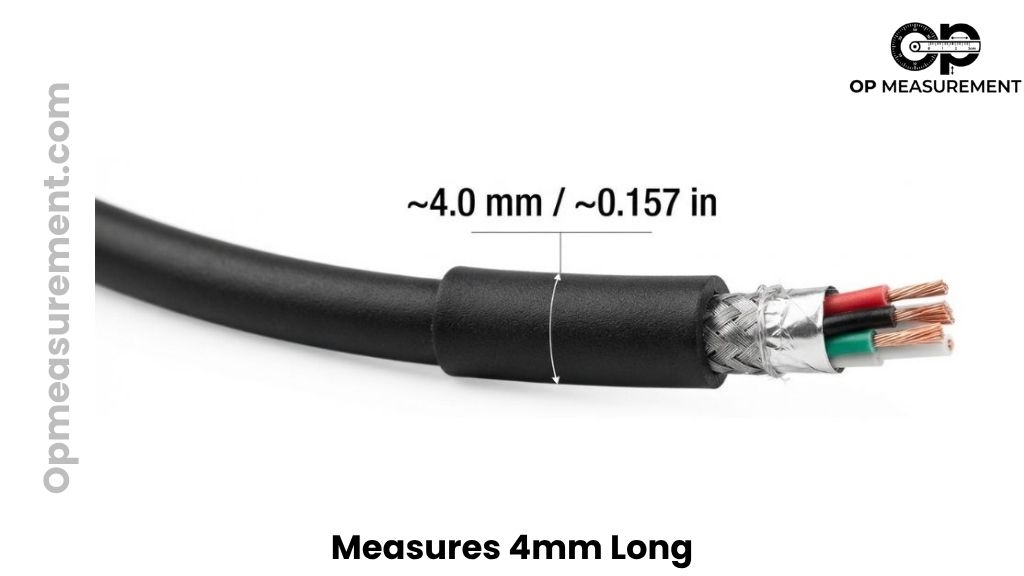
The outer diameter of a standard USB-A to USB-C or USB-A to Lightning cable is typically between 3.5 and 4.5 mm, depending on the cable’s quality and insulation thickness. Budget cables often run thinner, while braided or reinforced cables run closer to 4.5 mm or above. A mid-range standard cable without braiding tends to land right around 4 mm in outer diameter.
This is a useful reference because nearly everyone has a charging cable within arm’s reach. Rolling the cable between your fingers along its smooth middle section, not near a connector, gives you a practical feel for the 4 mm range. Just note that it’s an approximate reference, not a standardized one.
13. A Stack of 5 Credit Cards

A single credit card has a standardized thickness of 0.76 mm, defined by the ISO/IEC 7810 ID-1 standard. Five of them stacked together measure exactly 3.8 mm, which is very close to 4 mm. The slight gap to reach exactly 4 mm is small enough that this stack works as a practical, standardized thickness reference.
This comparison is particularly useful because credit cards are a rare everyday object with a truly fixed, internationally standardized thickness. If you ever need to check whether a gap, slot, or clearance is approximately 4 mm, a stack of five cards slides in and out cleanly at that dimension. It’s one of the more reliable improvised measuring tricks for this size.
For another size reference, see How Big Is 3mm?
Conversion reference: NIST unit definitions and conversion factors. Rounded values are for comparison; product dimensions and weights should be checked against the specific item.

Vera loves exploring the size and dimensions of everyday objects. She shares practical, visual guides to help readers understand measurements clearly. With a focus on accuracy and usefulness, Vera creates content that informs, engages, and supports learning for all.