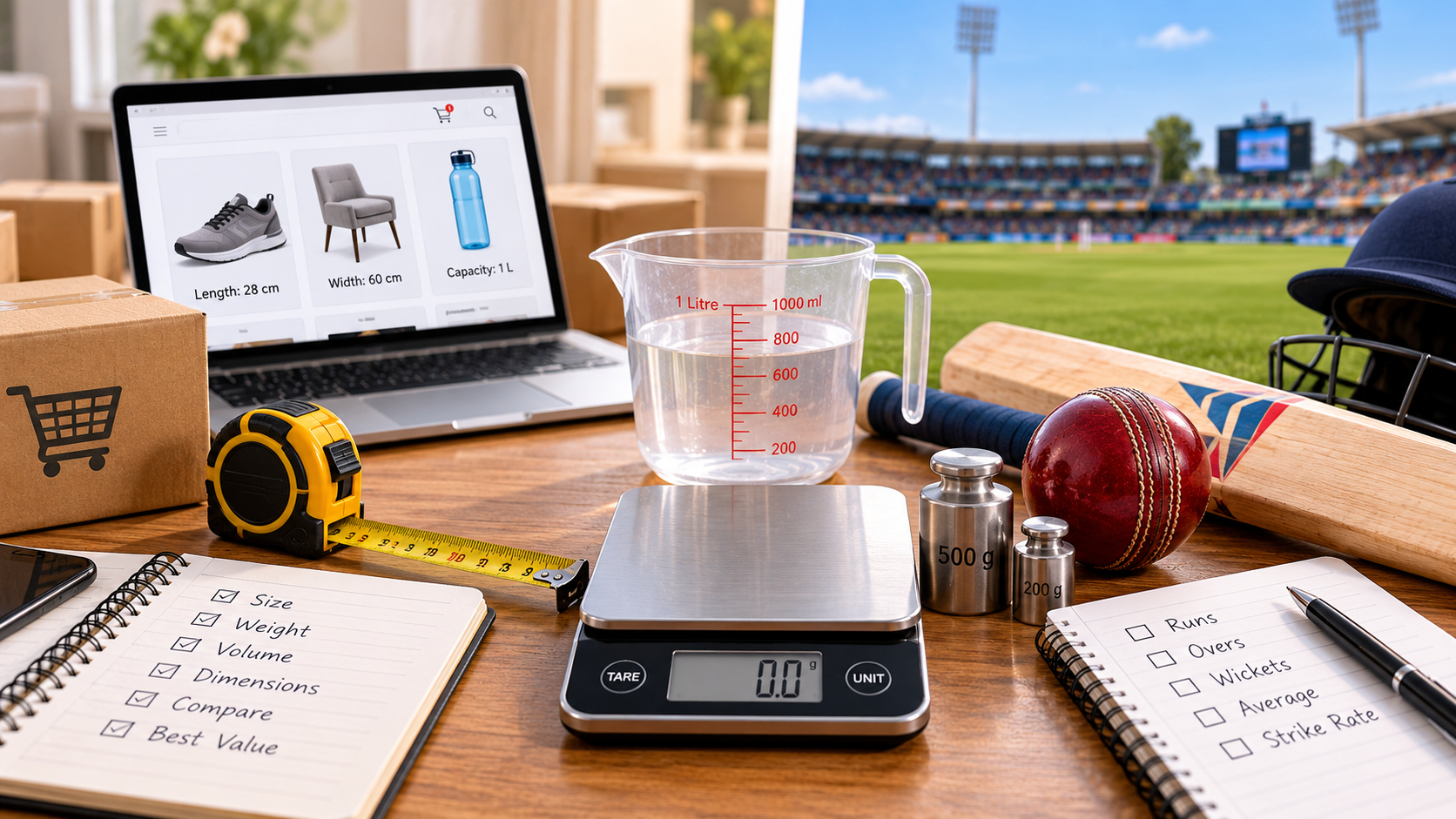
Measurements play an important role in everyday decisions, from choosing the right product to understanding the results of a sporting event. Whether someone is comparing product sizes, checking liquid quantities, calculating distances, or following cricket statistics, accurate measurements make information easier to understand and decisions more reliable.
Although shopping and sports may seem like two very different activities, both depend on numbers, comparisons, and clearly presented information. Measurements help consumers determine whether a product meets their needs, while sports statistics allow fans to evaluate performances, compare teams, and understand how competitions unfold.
Understanding measurements is therefore more than a mathematical exercise. It is a practical skill that helps people interpret information, avoid common mistakes, and make better-informed choices.
Why Measurements Are Important in Everyday Life:
Measurements provide a consistent way to describe quantities, dimensions, distances, and durations. Without standard units, comparing two products or evaluating sporting performances would become much more difficult.
For example, a shopper comparing two storage containers needs to understand their dimensions and capacities. Someone purchasing furniture must check whether the measurements fit the available space. Similarly, a cricket fan following a match needs to understand overs, runs, wickets, and other numerical indicators to interpret the score accurately.
Measurements also reduce ambiguity. Descriptions such as small, large, heavy, or lightweight can mean different things to different people. Numerical values provide a more precise basis for comparison.
Common measurements used in daily life include:
- Length: Used to compare product dimensions, furniture sizes, and distances.
- Weight: Helps shoppers compare packaged goods and understand quantities.
- Volume: Indicates the amount of liquid a container can hold.
- Time: Measures durations, deadlines, travel times, and sporting performances.
- Temperature: Helps consumers understand storage requirements and weather conditions.
- Percentages and ratios: Make it easier to compare proportions, statistics, and changes.
Knowing how these measurements work helps people interpret product information and everyday numerical data more confidently.
How Measurements Help Consumers Make Better Shopping Decisions:
Online shopping offers convenience, but it also requires customers to evaluate products using descriptions, photographs, specifications, and numerical information. Since shoppers cannot physically examine every item before purchasing it, measurements become especially important.
A product photograph may provide a general impression of its appearance, but it cannot always communicate its exact size or capacity. Checking the listed dimensions helps shoppers decide whether an item will suit their intended use.
For example, someone buying a desk should compare its height, width, and depth with the available workspace. A customer purchasing storage containers should examine their capacity rather than relying on photographs alone. Similarly, people comparing packaged products can use net weight or volume to understand how much they are receiving.
Understanding Product Dimensions
Length, width, and height are among the most common measurements found in product descriptions. These values help customers determine whether a product will fit into a particular space or meet their practical requirements.
However, it is important to understand how dimensions are presented. A measurement may describe the external dimensions of a product rather than its usable internal space. Packaging dimensions may also differ from the dimensions of the item itself.
Before purchasing a product, shoppers should check which measurements are provided and whether they relate to the product, its packaging, or its usable capacity.
Comparing Weight and Volume
Weight and volume are different measurements, even though they are sometimes confused.
Weight describes how heavy an object is, while volume describes the amount of space it occupies. A one-litre container, for example, indicates a capacity of one litre, but the weight of its contents depends on the material inside.
This distinction matters when comparing food packages, household liquids, personal-care products, and other consumer goods. Checking the correct unit helps shoppers avoid misleading comparisons.
When comparing similar products, customers should also consider the quantity included in each package. A lower price does not necessarily represent better value if the package contains substantially less product.
Reading Liquid Product Information
Liquid products often use millilitres or litres to communicate quantity. Understanding these units makes it easier to compare package sizes and interpret product descriptions.
For instance, 1 litre equals 1,000 millilitres. A bottle containing 500 millilitres therefore holds half the volume of a one-litre bottle.
Other product specifications may describe the composition or intended use of a liquid rather than its quantity. Consumers should distinguish between these details instead of assuming that every numerical value refers to volume.
Adults researching vaping products, for example, may encounter descriptions of bottle capacity, nicotine concentration, and liquid formulation. These specifications serve different purposes and should not be treated as interchangeable. Consumers can review product categories such as High VG shortfill e-liquids to see how product descriptions and terminology are used in this category. Product specifications should be read carefully, and vaping is not risk-free, particularly when products contain nicotine, which is addictive.
The broader lesson applies to all online purchases: understanding what a measurement represents is just as important as reading the number itself.
How Accurate Measurements Improve Value for Money:
Price is one of the first details shoppers notice, but it does not always reveal which product offers the best value.
When two products have different package sizes, comparing their unit prices can provide a clearer picture. Unit pricing expresses the cost per standard quantity, such as per kilogram, litre, or 100 grams.
Consider two packages of the same product:
- Package A contains 500 grams and costs ₹100.
- Package B contains 1 kilogram and costs ₹180.
Package A costs ₹200 per kilogram, while Package B costs ₹180 per kilogram. If the products are otherwise comparable, Package B offers a lower cost per kilogram.
This method is useful when comparing groceries, cleaning supplies, personal-care products, and other goods sold in different quantities.
However, unit price should not be the only consideration. Product quality, expiry dates, storage requirements, packaging waste, and the likelihood of using the entire quantity can also influence value.
Why Standard Units Matter
Standard units make comparisons possible across different products and retailers. The metric system, which includes millimetres, centimetres, metres, grams, kilograms, millilitres, and litres, is widely used in product specifications.
Consumers may occasionally encounter other units, such as inches, feet, pounds, or fluid ounces. Learning a few common conversions can help prevent mistakes when buying imported products or comparing information from different markets.
For a practical example of understanding dimensions, explore our guide to things that measure 10 feet.
For example:
- 1 metre equals 100 centimetres.
- 1 kilogram equals 1,000 grams.
- 1 litre equals 1,000 millilitres.
- 1 inch equals 2.54 centimetres.
These simple relationships help shoppers interpret specifications more accurately and compare products on a consistent basis.
The Role of Measurements in Sports:
Sports rely on measurements to establish rules, record performances, and determine results. Without consistent numerical standards, it would be difficult to compare achievements or decide the outcome of a competition fairly.
Different sports use different forms of measurement. Athletics tracks distances in metres, swimming competitions record times, and football matches use minutes and goals. Cricket combines several numerical indicators, including runs, overs, wickets, and individual player statistics.
These figures allow spectators to understand what is happening during a match and provide a common basis for evaluating performances.
Measurements are also important for officials, coaches, players, broadcasters, and analysts. Accurate records help establish results, identify patterns, and explain how a performance compares with previous achievements.
Understanding Cricket Measurements
Cricket is particularly dependent on numerical information. The score alone does not always explain how a match is progressing, so fans often consider several measurements together.
Important cricket statistics include:
- Runs: The number of runs scored by a batter or team.
- Wickets: The number of batters dismissed, which also indicates how many dismissals remain before an innings ends.
- Overs: The number of completed six-ball overs, with additional notation used for balls delivered in an incomplete over.
- Run rate: The average number of runs scored per over.
- Batting average: A statistic commonly used to assess a batter’s scoring record relative to dismissals.
- Bowling economy: The average number of runs conceded per over by a bowler.
Each statistic provides a different perspective. A team scoring 160 runs in 20 overs has an average run rate of eight runs per over. A score of 160 in 16 overs, by comparison, represents a run rate of ten runs per over.
The total number of runs is identical, but the scoring pace differs significantly. Understanding this distinction helps spectators interpret a team’s progress rather than focusing only on the final score.
Why Context Matters When Comparing Sports Statistics
Numbers are useful, but they do not always tell the complete story.
A batter’s performance may be influenced by the pitch, opposition bowling, match conditions, and the required scoring rate. Similarly, a bowler’s economy rate should be interpreted alongside factors such as wickets taken, overs bowled, and the stage of the innings.
Comparisons become more meaningful when statistics are considered in context. A high score in one match cannot automatically be considered better than a lower score in another if the conditions and match situations are substantially different.
The same principle applies across other sports. Comparing athletes solely by one measurement can overlook differences in competition format, playing time, equipment, or environmental conditions.
Reliable analysis therefore combines accurate numbers with an understanding of what those numbers represent.
How Team Information Helps Cricket Fans Understand Competitions:
Measurements and statistics become even more useful when fans understand the teams and players involved in a competition.
Team composition can influence how a side approaches a match. The balance between batters, bowlers, and all-rounders may affect its tactical options, while player availability can influence the selection of the playing eleven.
In franchise cricket, fans often follow squad announcements, player roles, and team changes throughout a tournament. Understanding these details provides useful context when interpreting performances and match statistics.
For readers following the International League T20, information about ILT20 team squads can help them explore the players associated with the competing teams. Squad information complements numerical analysis by giving fans a clearer picture of the personnel behind the statistics.
For example, a team’s bowling figures become more informative when spectators know which bowlers are available and what roles they generally perform. Similarly, batting statistics are easier to interpret when considered alongside a player’s position in the batting order and expected responsibilities.
Team information and numerical records therefore work together. Statistics explain what happened, while information about players and team composition helps provide context for understanding those results.
The Connection Between Measurements, Technology, and Data:
Digital platforms have made measurements and statistics easier to access. Online retailers can display product dimensions, capacity, weight, and other specifications alongside photographs. Sports websites can publish live scores, player statistics, team information, and historical records.
These tools improve accessibility, but they also make accurate data presentation essential.
A measurement entered incorrectly into a product listing can lead to an unsuitable purchase. An error in a sports score can create confusion about the state of a match. Even when the original data is correct, unclear labels or inconsistent units can make it difficult for users to interpret.
Good information design should make important details easy to find and understand.
For product listings, this means presenting dimensions with clearly identified units and explaining specifications that might otherwise be ambiguous. For sports statistics, it means distinguishing completed overs from balls delivered, individual records from team totals, and current figures from historical averages.
Digital tools can also help users convert units and compare values. However, users should still check the original information and confirm that comparisons are based on equivalent measurements.
Technology makes information more accessible, but accuracy and clarity remain essential.
Common Measurement Mistakes to Avoid:
Even simple numerical information can be misunderstood when units, definitions, or context are overlooked.
Several practical habits can help prevent common errors.
1. Confusing Different Units
Grams and kilograms measure weight, while millilitres and litres measure volume. Although some everyday products may have similar numerical values across these units, they are not interchangeable.
Always check the unit displayed alongside a number.
2. Comparing Products Without Checking Quantity
Two packages may look similar but contain different quantities. Compare the net weight, volume, dimensions, or unit price before deciding which offers better value.
3. Ignoring Product Dimensions
A product may appear suitable in a photograph but fail to fit the intended space. Check the listed measurements and confirm whether they refer to the item itself or its packaging.
4. Interpreting Sports Statistics in Isolation
A single score or average rarely explains an entire sporting performance. Consider match conditions, playing time, opposition, and the role of the player before drawing conclusions.
5. Overlooking the Meaning of Statistical Notation
In cricket, an over consists of six legal deliveries, and a notation such as 19.4 represents 19 completed overs and four legal balls in the next over, not 19.4 decimal overs.
Understanding the notation is important when calculating run rates or interpreting bowling figures.
6. Assuming Every Published Number Is Accurate
Online information can contain outdated figures, typing errors, or unclear descriptions. When a measurement or statistic seems unusual, check the source and look for confirmation from reliable documentation or official records.
These habits help consumers and sports fans use numerical information more confidently.
How to Become Better at Interpreting Measurements:
Developing measurement literacy does not require advanced mathematics. A few consistent habits can make a meaningful difference.
Start by becoming familiar with common units and their conversions. When shopping, read the specifications before making a decision and compare products using the same unit. If a listing provides several dimensions, consider how each one affects the intended use.
When following sports, learn the basic definitions behind the most frequently reported statistics. Rather than looking at a score in isolation, examine how it relates to overs, wickets, player contributions, and match conditions.
It is also useful to ask three questions whenever a number appears:
- What is being measured? Identify whether the figure describes length, weight, volume, time, performance, or another quantity.
- Which unit or method is being used? Check whether the number is expressed in centimetres, kilograms, litres, overs, percentages, or another standard.
- What does the number tell me in context? Consider whether it is being compared with an equivalent product, performance, or situation.
These questions encourage careful interpretation instead of relying on assumptions.
Conclusion:
Measurements make everyday information more useful by providing a consistent way to describe quantities, compare products, and evaluate performances. In shopping, they help consumers understand dimensions, compare package sizes, calculate unit prices, and select products that meet their needs. In sports, they allow fans to interpret scores, assess player performances, and understand the factors that influence match results.
The most important skill is not simply knowing how to read a number. It is understanding what the number represents, which unit or method is being used, and how the information relates to the situation.
By developing these habits, shoppers can make more informed purchasing decisions, while sports fans can follow competitions with a clearer understanding of the statistics behind the action. In both settings, accurate measurements and reliable information turn numbers into practical knowledge.