8 millimeters equals 0.8 centimeters and approximately 0.3150 inches. Compare the specific dimension named below—diameter, width, length, or thickness. Natural objects and product sizes vary; check a ruler, caliper, or manufacturer specification before treating an example as exact.
Eight millimeters sits in an interesting zone. It is small enough to overlook at a glance, yet large enough to hold between your fingers and feel something solid. On a ruler, it falls just short of a centimeter, which itself is roughly the width of a fingernail. In decimal inches, 8mm converts to exactly 0.3150 inches, or just under 5/16 of an inch.
Most people encounter this size without ever naming it. It shows up in jewelry, hardware, sewing, fashion accessories, and vintage film. Getting a clear mental picture of it takes a few good reference points, and the thirteen objects below offer a range of useful ones.
Quick Reference: 13 Things That Are 8mm
| Object | Dimension Type | Status |
| Medium Plastic Drinking Straw | Outer diameter | Approximate |
| Men’s Wedding Band Width | Width | Standardized common size |
| Standard Bic Cristal Ballpoint Pen Cap | Outer diameter | Approximate |
| Large Chickpea | Diameter | Natural/approximate |
| Blueberry | Diameter | Natural/approximate |
| Small Shirt Button | Diameter | Nominal/approximate |
| USB Type-C Plug Metal Shroud | Width | Standardized |
| 8mm Film Strip | Width | Exact standard |
| Common Snap Fastener | Diameter | Approximate |
| Adult Pinky Fingernail | Width | Natural/approximate |
| Cultured Pearl | Diameter | Approximate |
| M5 Hex Nut | Width across flats | Standardized |
| Masonry Wall Plug | Diameter | Nominal |
The 13 Objects Up Close
1. Medium Plastic Drinking Straw

The outer diameter of a standard plastic drinking straw used in restaurants and cafes typically falls right around 8mm. This is the size you would find in most paper-wrapped individually packaged straws that accompany soft drinks. The inner bore is narrower, usually around 5 to 6mm, so the wall thickness accounts for the rest.
This is a useful reference because straws are easy to hold between two fingers and rotate, giving you a tactile sense of an 8mm cylinder. It is worth noting that jumbo smoothie straws and cocktail straws differ and fall outside this range.
2. Men’s Wedding Band Width

An 8mm wedding band is one of the most popular widths sold for men. Jewelers frequently stock this width because it sits in a comfortable middle ground: wide enough to feel substantial on the finger and to accommodate engraving or design detail, but not so wide that it restricts movement at the knuckle.
Comparing an 8mm band to a 6mm one side by side reveals a clear visible difference. The 8mm version covers a noticeably larger portion of the finger. This is a standardized nominal size in the jewelry trade, though the actual finished width can vary by a fraction of a millimeter depending on the manufacturing process.
3. Standard Bic Cristal Ballpoint Pen Cap

The outer diameter of a Bic Cristal pen cap measures close to 8mm. The Bic Cristal is one of the most produced ballpoint pens in history, which makes its dimensions a reasonably accessible reference. The cap itself is slightly tapered, so the measurement varies slightly from top to base, but the mid-section sits near this value.
This object is useful precisely because most people have held one. When you recall the size of that cap between your fingers, you have a reasonable physical memory of roughly 8mm in cross-section.
4. Large Chickpea
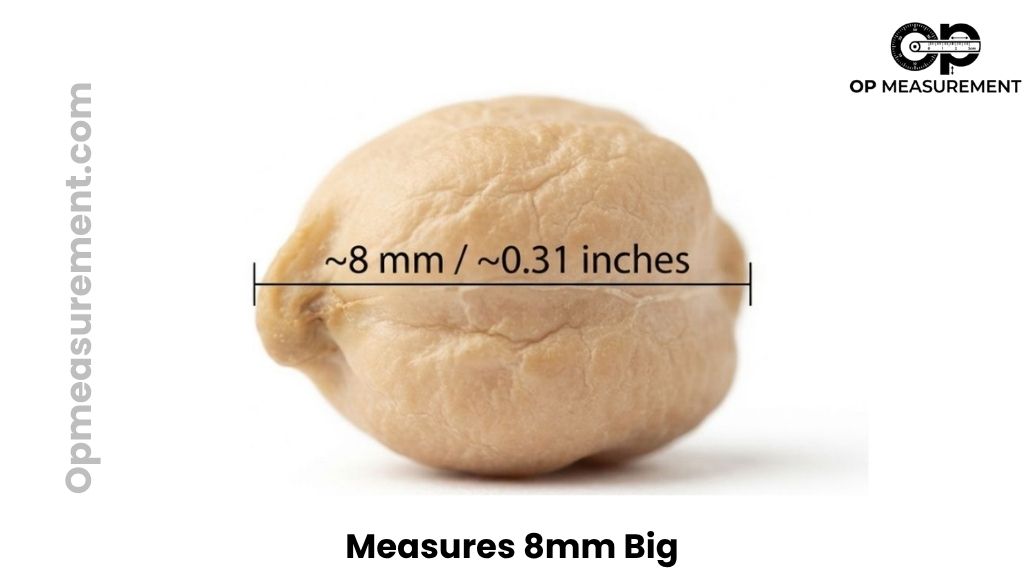
A large, fully hydrated chickpea typically falls in the 8 to 10mm range in its shorter diameter. A particularly round, plump specimen can reach 8mm across its narrower axis when measured with calipers after soaking. Dried chickpeas are smaller before hydration.
Because chickpeas are naturally grown legumes, individual sizes vary considerably. What makes a chickpea a useful comparison is that most people have handled them in cooking and already carry an intuitive sense of their size. The 8mm figure represents a solid, well-developed specimen rather than a small or shriveled one.
5. Blueberry
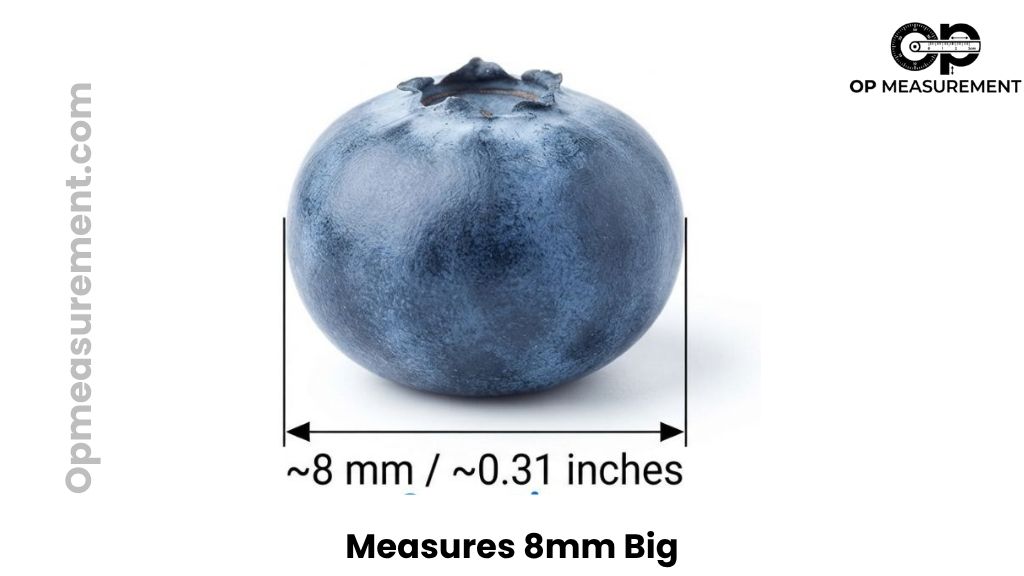
A medium-to-large cultivated blueberry measures approximately 8 to 12mm in diameter. An 8mm blueberry sits toward the smaller end of what you would expect from a grocery store punnet. Wild blueberries tend to run smaller, while select premium cultivars can exceed 15mm.
The comparison is useful for scale rather than as a precise reference. An 8mm blueberry is one you would pick out of a bowl and eat in one bite without it feeling particularly large. Because berry size varies with variety, growing conditions, and ripeness, this should be treated as a naturalistic approximation rather than a fixed measurement.
6. Small Shirt Button

Shirt buttons used on dress shirts and casual tops come in a range of sizes, and the smaller buttons typically found on shirt cuffs or as the topmost collar button tend to cluster around 8mm in diameter. Garment manufacturers often specify button sizes in lignes, an old French unit. An 8mm button corresponds to approximately 18 lignes.
The texture and appearance of an 8mm button depend entirely on the material, whether it is polyester resin, mother-of-pearl, corozo nut, or nylon. The size itself is nominal; actual finished buttons may measure anywhere from 7.5 to 8.5mm depending on the manufacturer.
Read more: How Big Is 4mm?
7. USB Type-C Plug Metal Shroud

The USB Type-C connector has a standardized cross-section. The metal shroud, which is the outer oval housing of the plug, measures approximately 8.25mm wide and 2.4mm tall according to the USB Type-C specification. The width of roughly 8mm makes it a precise and verifiable reference point for that dimension.
This is also a meaningful size context: the USB-C connector was designed to be small enough for thin devices like ultrabooks and smartphones while still being robust enough for repeated insertion cycles. Its near-8mm width is a deliberate engineering choice rather than an arbitrary dimension.
8. 8mm Film Strip

The 8mm film format is named directly after its width: the strip measures exactly 8mm across. This format was introduced by Kodak in 1932 as a lower-cost alternative to 16mm film, intended for home movie use. The film was originally 16mm wide and perforated along both edges; it was run through the camera twice and then split down the middle after processing.
Each frame on Standard 8mm film is quite small, which is why the image quality of footage from this format looks noticeably grainy compared to larger gauges. Super 8, introduced later, uses the same 8mm film width but with smaller perforations to allow a larger frame area.
9. Common Snap Fastener

The snap fasteners used on jackets, children’s clothing, bags, and upholstery come in several sizes. The most commonly encountered size in light clothing and craft applications has a cap diameter in the range of 10 to 12mm, but smaller snaps used in baby garments, thin fabrics, and accessories frequently measure closer to 8mm across the cap.
These smaller snaps are often sold as size 16 or size 20 snaps depending on the brand’s sizing system, which makes direct comparison tricky. An 8mm snap cap is noticeably compact, and the snap mechanism requires careful alignment because the tolerance between the cap and the socket is tight at this scale.
Read also: How Big Is 5mm?
10. Adult Pinky Fingernail
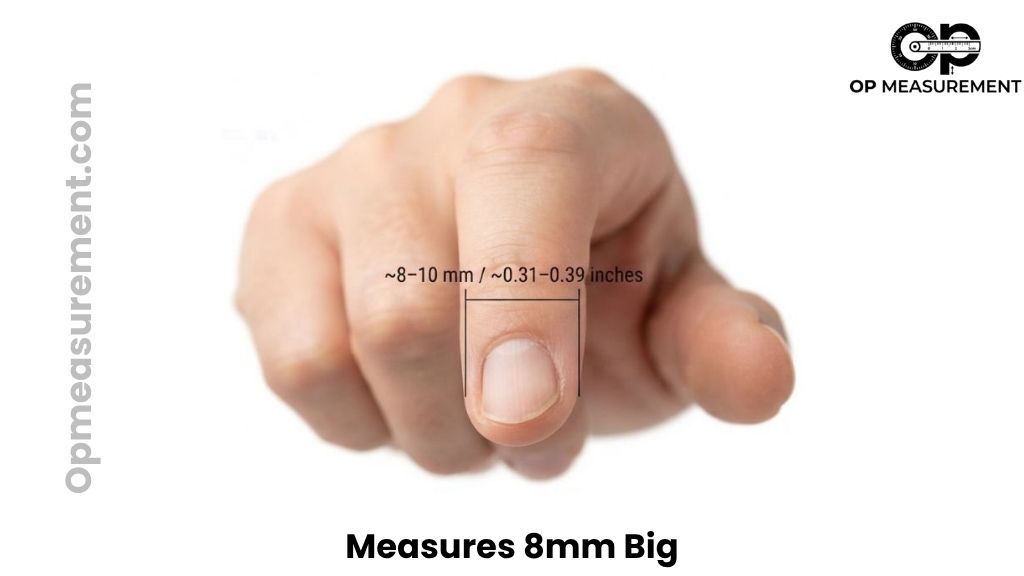
The width of an adult pinky fingernail varies considerably between individuals, but the average falls somewhere between 7 and 10mm. An 8mm pinky nail width represents a realistic middle value for an adult with average hand proportions.
This is a natural measurement, which means it cannot be used as a precise reference. Nail width depends on sex, genetics, age, and even which hand is being measured. What it offers is a quick bodily sense of scale: 8mm is roughly the breadth of the narrowest finger on most adult hands.
11. Cultured Pearl
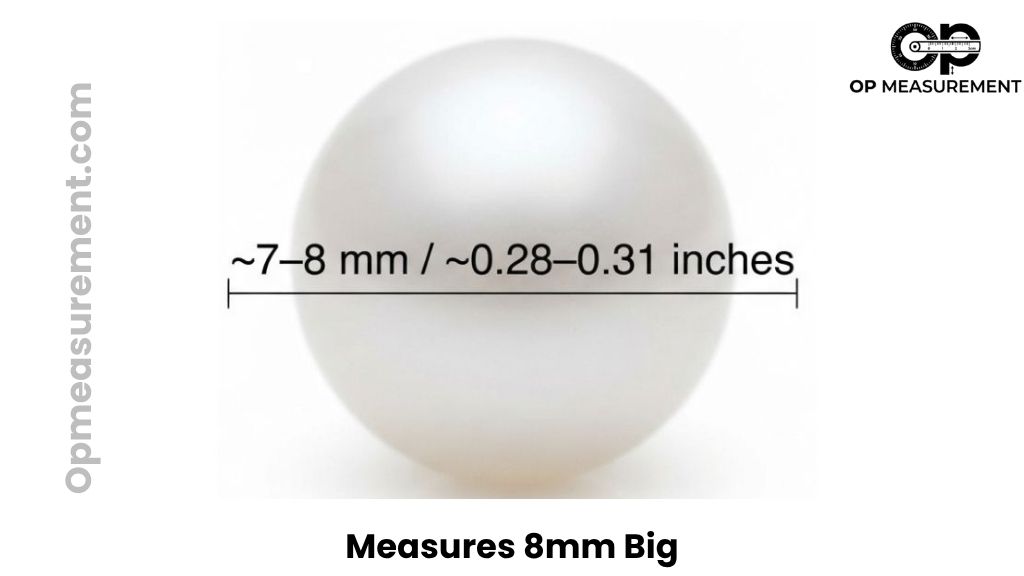
Cultured pearls sold in jewelry are graded partly by diameter, and the 7 to 8mm range represents one of the most commercially popular sizes for Akoya pearls. An 8mm pearl is considered on the larger side for this type, which comes from Japanese and Chinese saltwater oysters. Freshwater cultured pearls can reach 8mm more easily because the culturing process differs.
An 8mm cultured pearl has a noticeable presence on a strand necklace. For reference, a 6mm pearl looks delicate and understated, while a 10mm pearl reads as clearly substantial. The 8mm pearl sits at a point that reads as elegant without appearing oversized on most necklines.
12. M5 Hex Nut
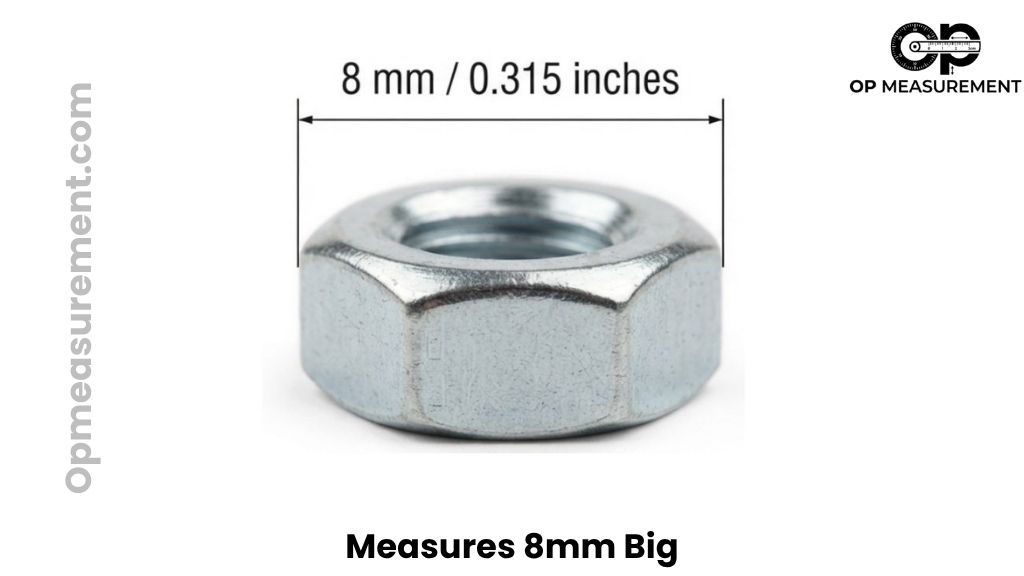
An M5 hex nut is designed to pair with an M5 metric bolt, which has a 5mm shank diameter. The nut itself has a width across its flat faces of exactly 8mm, according to ISO 4032 standards. This is one of the most precise and verifiable 8mm references available, because it is a dimensionally standardized fastener manufactured to tight tolerances.
The M5 nut appears widely in electronics enclosures, bicycle components, small machinery, and 3D printer frames. If you have access to a hardware store or a parts bin, an M5 hex nut gives you a accurate 8mm reference that you can place directly against a ruler to confirm.
13. Masonry Wall Plug
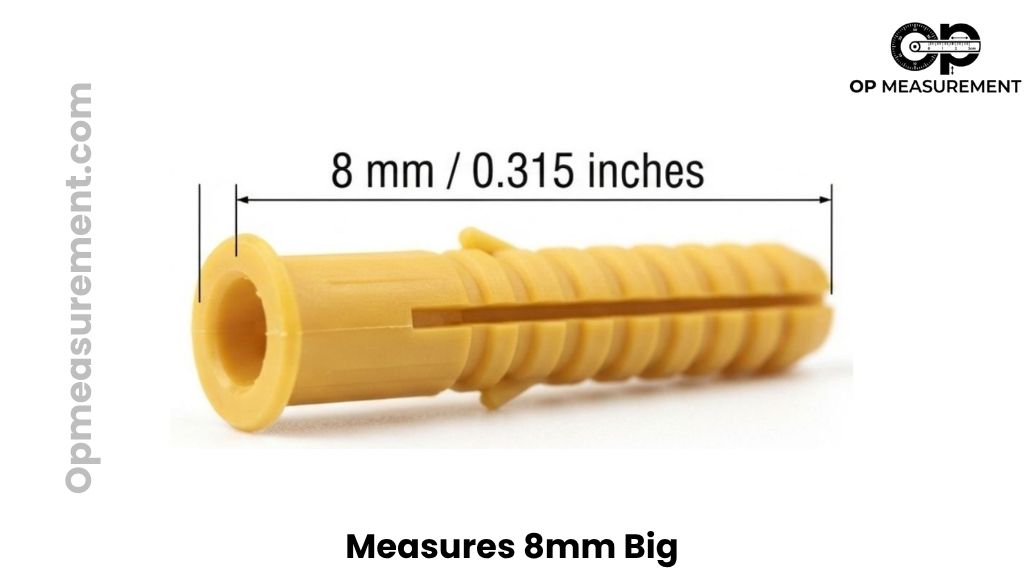
Masonry wall plugs, the plastic anchors inserted into drilled holes before driving in a screw, are sold by the nominal drill bit size they pair with. An 8mm wall plug is one of the common sizes used for medium-duty fixings in brick, concrete, and blockwork. The plug body diameter is nominally 8mm, sized to fit a hole drilled with an 8mm masonry bit.
In practice, the actual plug body may be fractionally smaller to allow insertion, and it expands as the screw is driven in to grip the surrounding material. These are widely available in DIY and hardware stores and provide a solid, tangible object to hold when trying to understand 8mm as a physical size.
For another size reference, see How Big Is 9mm? and How Big Is 7mm?
Conversion reference: NIST unit definitions and conversion factors. Rounded values are for comparison; product dimensions and weights should be checked against the specific item.

Vera loves exploring the size and dimensions of everyday objects. She shares practical, visual guides to help readers understand measurements clearly. With a focus on accuracy and usefulness, Vera creates content that informs, engages, and supports learning for all.