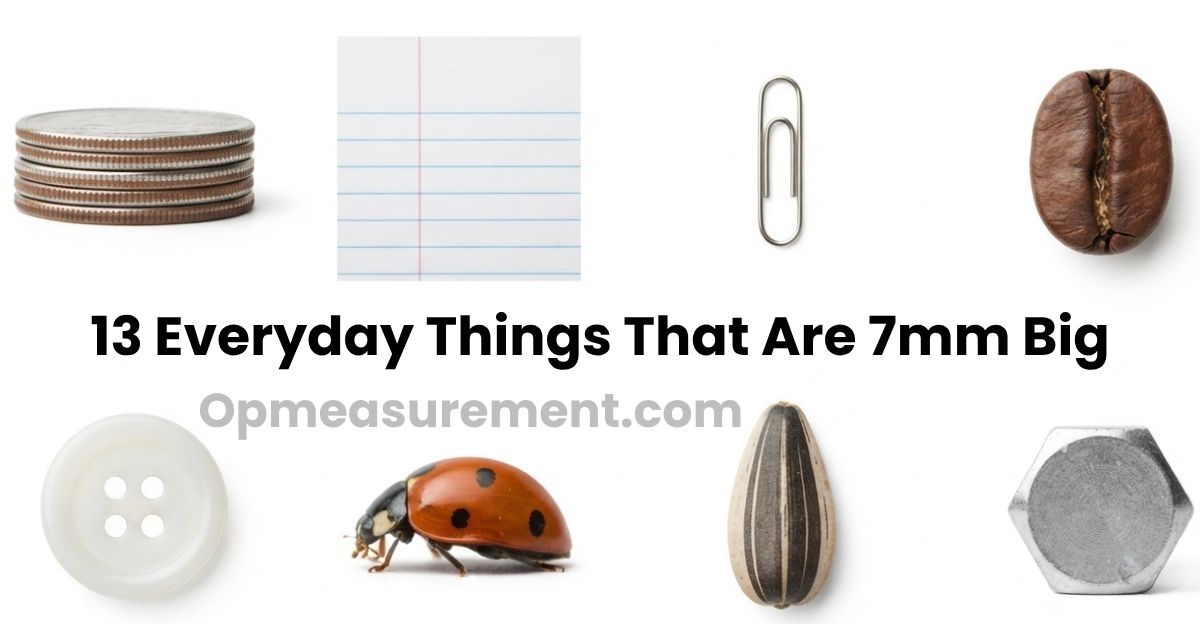
Seven millimeters sits in an interesting middle ground. It’s too small to measure comfortably with your fingertip, yet large enough to see clearly without magnification. On a ruler, it falls just short of the first centimeter mark, occupying about a quarter of an inch of space. To be precise, 7mm converts to 0.2756 inches, or roughly 9/32 of an inch.
If you’ve ever looked at a ruler and thought “I can picture a centimeter, but 7mm is harder to pin down,” you’re not alone. The examples below are chosen to make that gap disappear. Each one represents a real, measurable dimension at this size, so you walk away with a genuine mental anchor.
Quick Reference: 13 Things That Are 7mm
| Object | Dimension Type | Notes |
| Stack of 4 Standard US Quarters | Thickness | ~6.96mm stacked |
| Standard Hexagonal Wooden Pencil (Flat-to-Flat) | Width | Nominal ~7mm |
| College-Ruled Paper Line Spacing | Height/Spacing | Standardized 7.1mm |
| Small No. 3 Metal Paperclip | Width | Outer wire span ~7mm |
| Hexagonal Pencil (Corner-to-Corner) | Diameter | Slightly wider than flat-to-flat |
| Standard No. 7 Zipper Chain | Width | Nominal 7mm chain width |
| Standard Plastic Drinking Straw | Outer Diameter | Typical ~7-8mm OD |
| Graded Arabica Coffee Bean | Width | Typical screen-grade width |
| Standard Shirt Button (Size 11 Ligne) | Diameter | ~7mm finished button |
| Adult Housefly (Musca domestica) | Body Length | Typical adult range |
| Mature Seven-Spot Ladybug | Body Length | Common UK/US species |
| Commercial Striped Sunflower Seed | Width | Shelled seed width |
| Mini Hot Glue Gun Stick | Diameter | Standard mini stick |
1. Adult Housefly (Musca domestica)
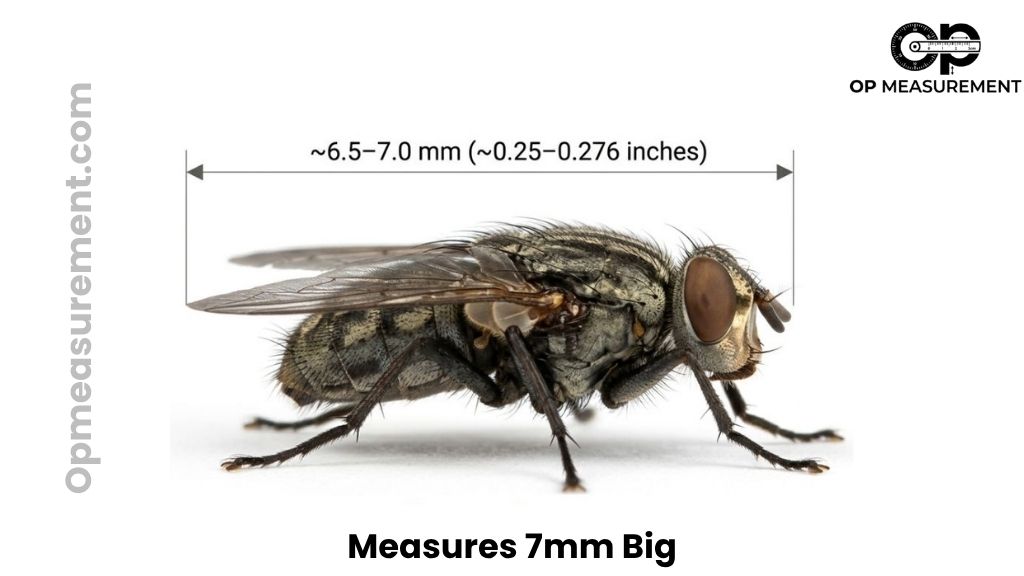
The common housefly lands almost perfectly in the 7mm range for body length, measured from head to the tip of the abdomen. This excludes the wings, which extend considerably farther. It’s a useful natural reference because nearly everyone has seen one at close range, whether on a windowsill or a table.
What makes this comparison particularly handy is that the housefly’s width is noticeably narrower than its length, so when you’re imagining 7mm, think specifically of the length running head to tail. The body itself is compact and cylindrical, which makes the length easier to mentally isolate than the overall wingspan.
2. Standard No. 7 Zipper Chain
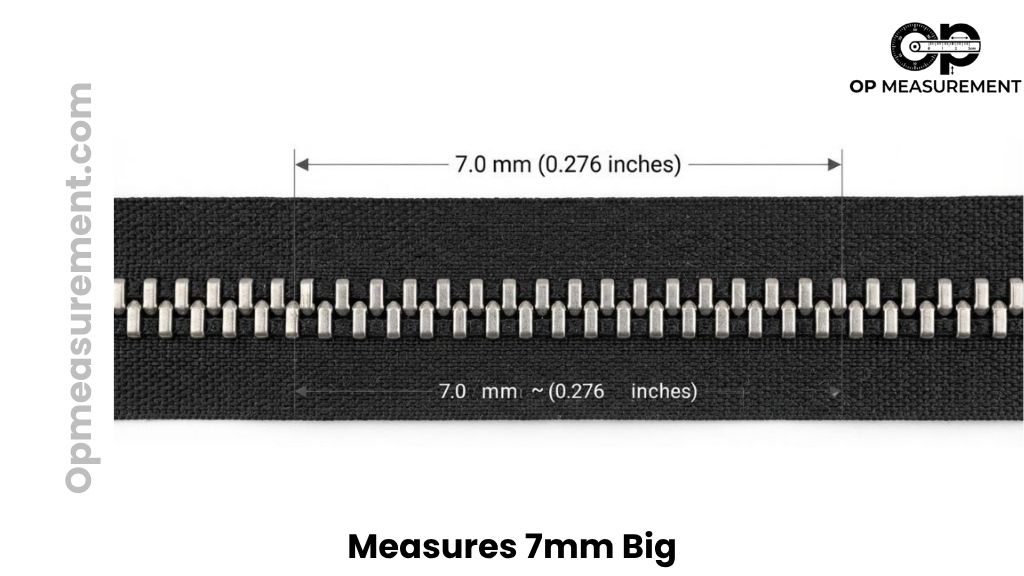
The number on a zipper refers to the nominal width of the closed chain in millimeters, so a No. 7 zipper has a chain width of approximately 7mm. This is a standardized specification used across the apparel and luggage industries, not an estimate. Run your finger along the teeth of a medium-weight jacket zipper and you’re feeling that exact width.
This comparison is useful because zippers are tactile. You can hold one, look at it, and see precisely where 7mm falls in physical space. No. 7 zippers are commonly found on backpacks, sportswear, and heavier jackets, so they aren’t hard to locate.
3. Mature Seven-Spot Ladybug
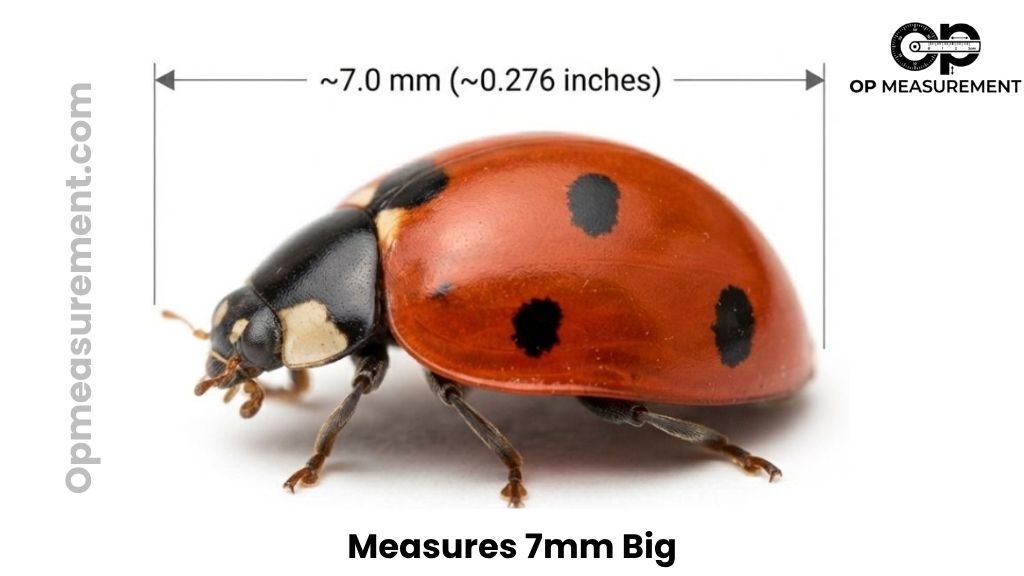
The seven-spot ladybug, one of the most recognized beetles in North America and Europe, reaches a body length of roughly 5mm to 8mm when mature, with many adults falling close to 7mm. The bright red elytra with black spots make it easy to picture, and the size feels instinctively small but not microscopic.
The body width of this species runs slightly less than its length, giving it a rounded oval shape. When you picture the length from the head to the rear of the wing covers, that’s the 7mm dimension in play, not the width or the leg span.
4. Stack of 4 Standard US Quarters
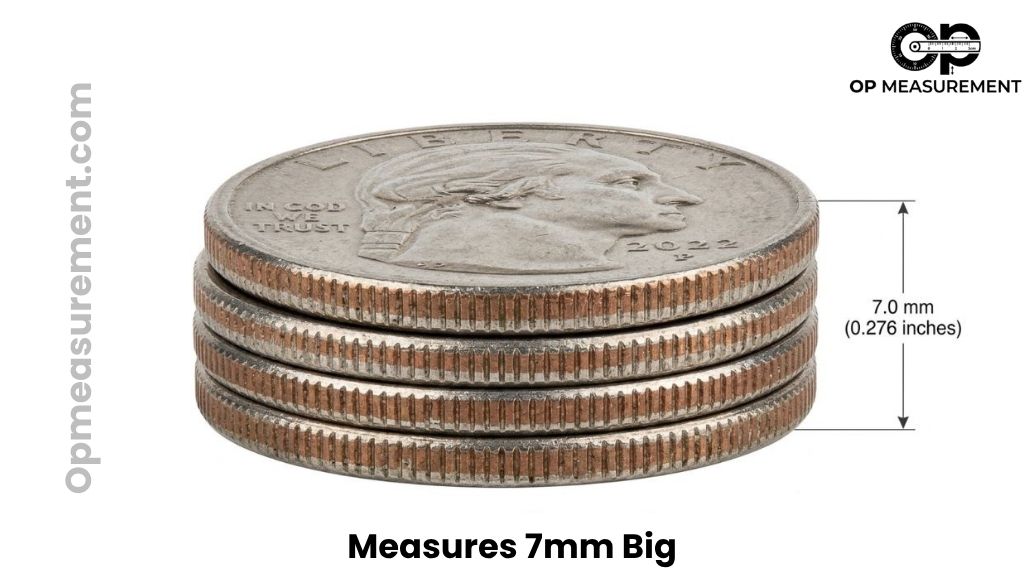
A single US quarter has a thickness of 1.75mm, which is a federally standardized specification maintained by the United States Mint. Stack four of them and you get 7.00mm exactly by that figure, making this one of the most precise everyday comparisons available for this measurement.
Four quarters aren’t just mathematically convenient. They form a stack you can actually hold between two fingers and measure against a ruler to confirm the figure yourself. The coins are uniform enough that variation between individual pieces is negligible for this purpose.
5. Standard Hexagonal Wooden Pencil (Flat-to-Flat)
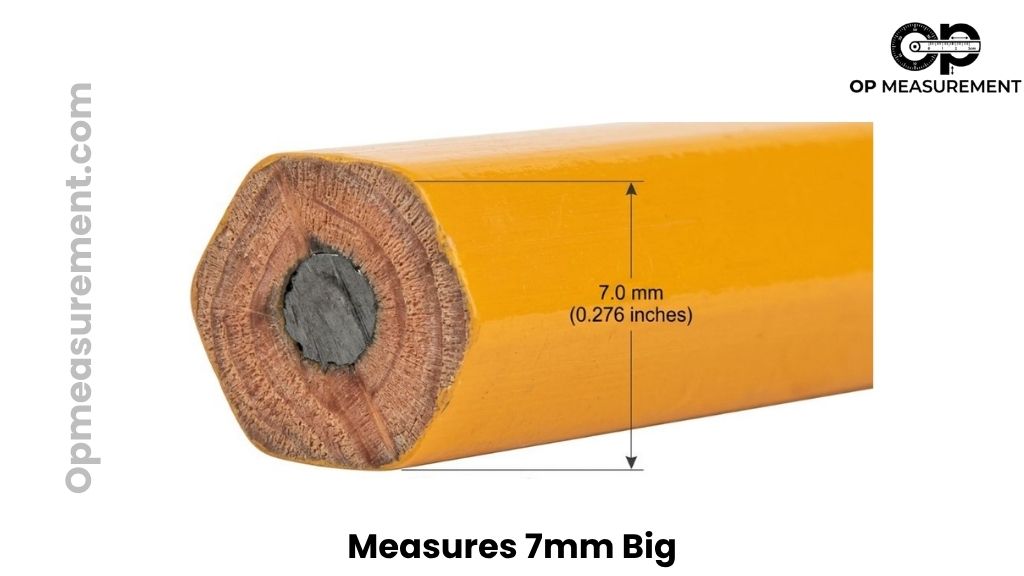
The flat-to-flat measurement of a standard hexagonal wooden pencil, meaning the distance across two parallel flat faces, runs close to 7mm on most school and office pencils. This is the most natural way to measure a hexagonal shape and the dimension you’d record if you placed it against a ruler at its widest flat side.
Pencil bodies aren’t governed by a single global standard, so there is some variation between manufacturers. However, the 7mm flat-to-flat figure represents the widely used size for general-purpose pencils, particularly those intended for writing rather than drafting or art.
6. Graded Arabica Coffee Bean
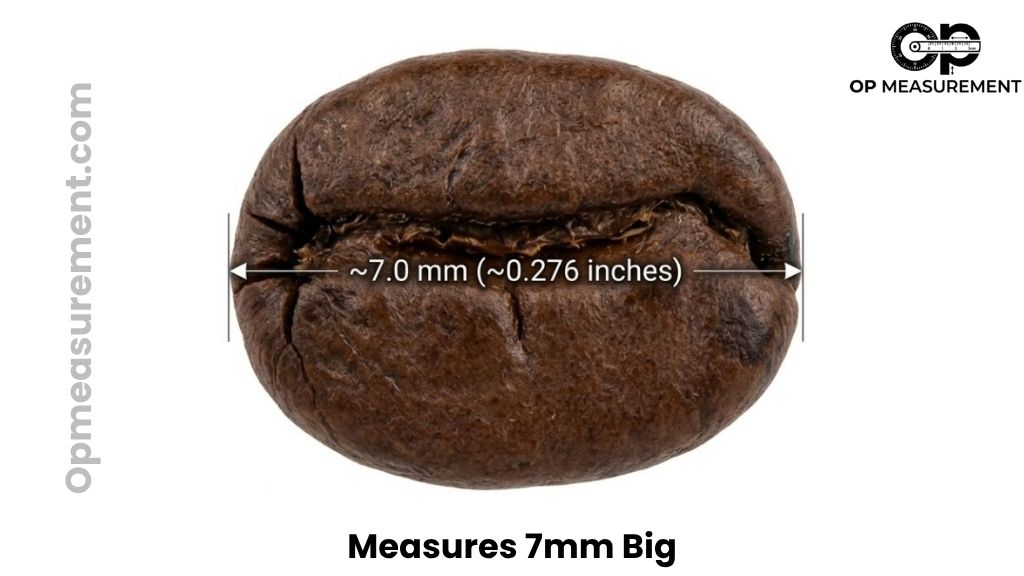
Green Arabica coffee is graded using screens with round holes sized in units of 1/64 inch. A Screen 17 hole measures approximately 6.75mm and Screen 18 measures about 7.1mm, which means beans that pass Screen 18 grading are close to 7mm in their shorter cross-sectional width. Premium specialty coffees are often Screen 15 and above, placing many high-grade beans near this size.
The 7mm dimension applies to the bean’s width, not its length. A coffee bean is oblong, so its length is noticeably greater. When you hold a single Arabica bean and look at it from the side, the short dimension across the flat face gives you the approximate 7mm reference.
7. Small No. 3 Metal Paperclip
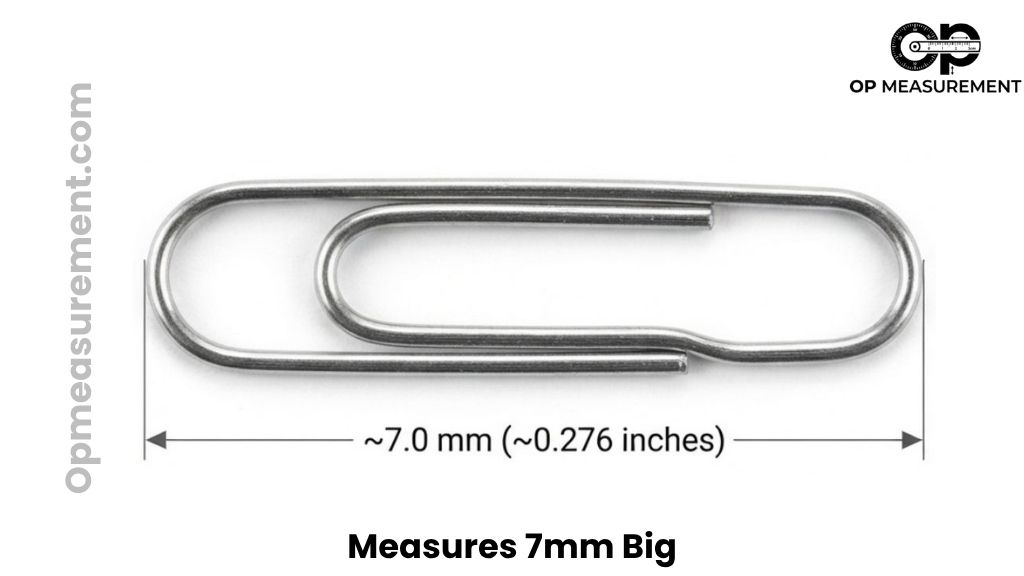
Standard metal paperclips come in several sizes, and the No. 3 small clip has an outer wire-to-wire span of approximately 7mm at its widest point. This is the distance across the outer loop, not the length of the clip. The length of a No. 3 clip is around 28mm, which is a very different measurement.
The width comparison is worth keeping in mind because it highlights the importance of specifying which dimension you’re discussing. If you pick up a small paperclip and measure its width rather than its length, the 7mm figure becomes immediately tangible without any tools.
Read also: 11 Things That Are 3mm Thick, Long, or Wide
8. Mini Hot Glue Gun Stick
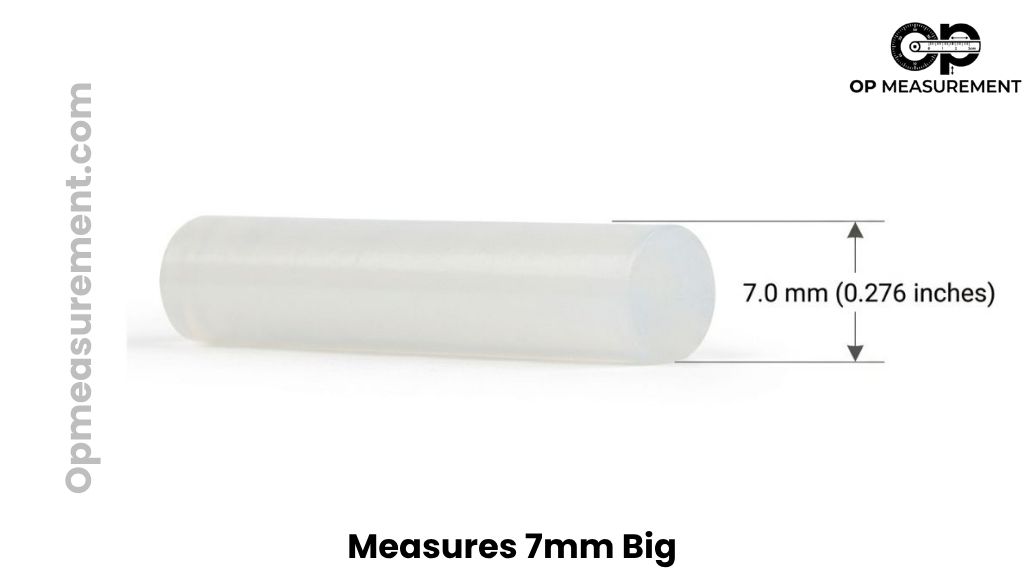
Mini hot glue gun sticks, the type used with compact or low-temperature craft glue guns, have a nominal diameter of 7mm. This distinguishes them clearly from full-size glue sticks, which run approximately 11mm to 12mm in diameter. The 7mm figure is a standard the craft supply industry has settled on for the mini format.
Pick up one of these sticks and roll it between your fingers, and the diameter feels slightly thicker than a standard wooden pencil’s cylindrical core but noticeably thinner than a full-size glue stick. The circular cross-section makes it a clean, simple reference for diameter at this size.
9. College-Ruled Paper Line Spacing
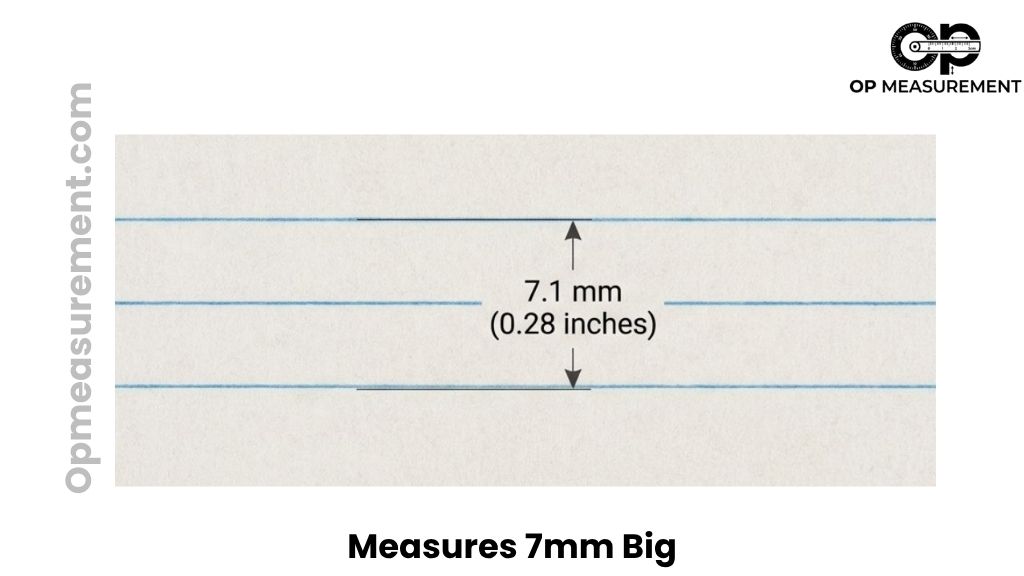
College-ruled notebook paper uses a line spacing of 7.1mm between ruled lines. This is close enough to 7mm to make a useful practical reference. Wide-ruled paper, by comparison, uses 8.7mm spacing, which is why college-ruled paper manages to fit noticeably more lines on the same page.
You can use a sheet of college-ruled paper as a direct measuring aid for objects near 7mm. Place a small item between two lines and you’ll see immediately whether it fits within a single line space. The difference between fitting comfortably and overflowing the space tells you a lot about whether something is closer to 7mm or 9mm.
10. Standard Plastic Drinking Straw
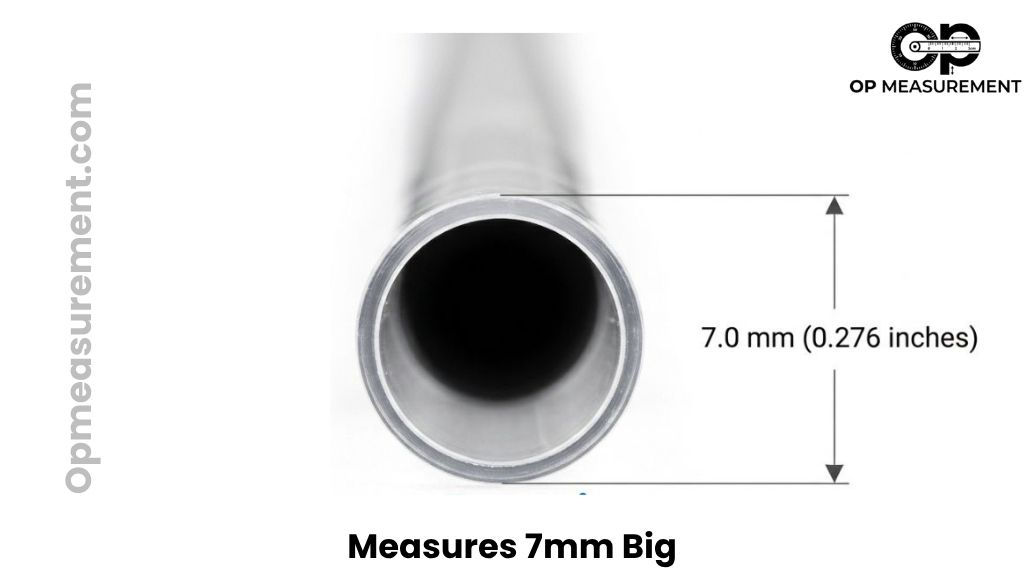
A standard plastic drinking straw used for cold beverages has an outer diameter that typically falls in the 7mm to 8mm range, depending on the manufacturer. The inner diameter is narrower, usually around 5mm to 6mm, which is the channel through which liquid actually flows. When referencing 7mm, the outer diameter is the relevant measurement.
This comparison is practical because straws are everywhere. If you place a straw flat on a ruler, the outer diameter is easy to see and compare. Jumbo straws used for thick drinks like smoothies or bubble tea are noticeably wider, which makes the standard straw a clear point of contrast for this size.
11. Hexagonal Pencil Thickness (Corner-to-Corner)
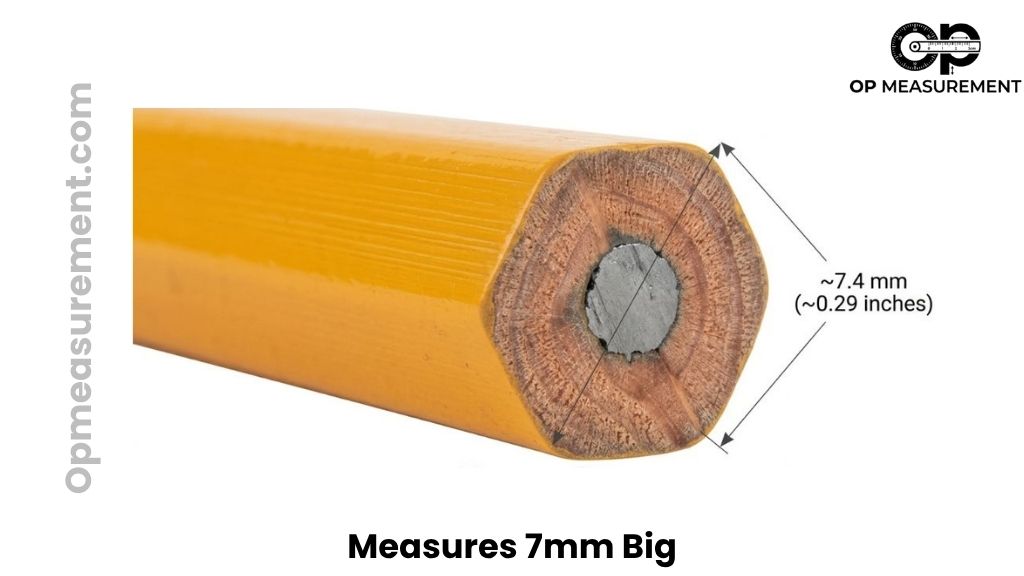
While the flat-to-flat measurement of a hexagonal pencil is close to 7mm, the corner-to-corner measurement, which is the distance across two opposite corners, runs slightly larger. On a standard pencil, this diagonal measurement is typically around 8mm. Listing it separately is useful because people often instinctively grab a pencil and measure it at an angle rather than flat-to-flat.
Understanding both dimensions of the same pencil illustrates how a single object can give you two different reference points depending on how you orient it. If you use a pencil to estimate 7mm, make sure you’re measuring flat side to flat side, not corner to corner.
12. Standard Shirt Button (Size 11 Ligne)
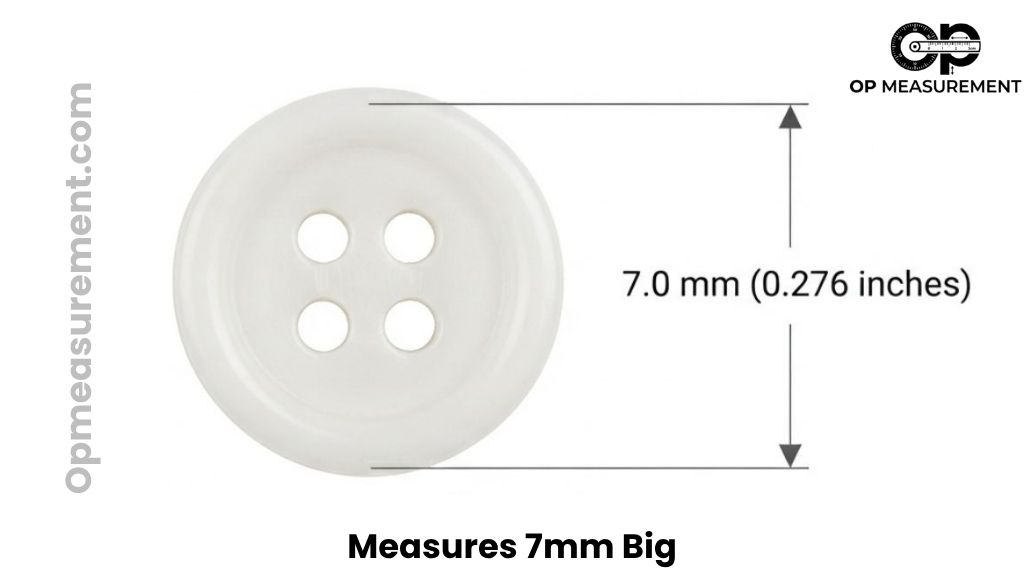
Button sizes are measured in ligne, an old French unit where 1 ligne equals approximately 0.635mm. A size 11 ligne button works out to about 6.99mm in diameter, which rounds cleanly to 7mm. This size is common on dress shirts, particularly for the smaller buttons found on cuffs or collar buttons on lighter garments.
What makes this useful is that shirt buttons are one of the few everyday objects where a specific size designation maps almost exactly to a metric dimension. A size 11 ligne button sitting in your hand gives you a near-perfect 7mm circle to reference, and you can confirm its size simply by measuring across the face with a caliper or a fine ruler.
Read more: 14 Things That Are 2mm: Real-World Size Comparisons
13. Commercial Striped Sunflower Seed
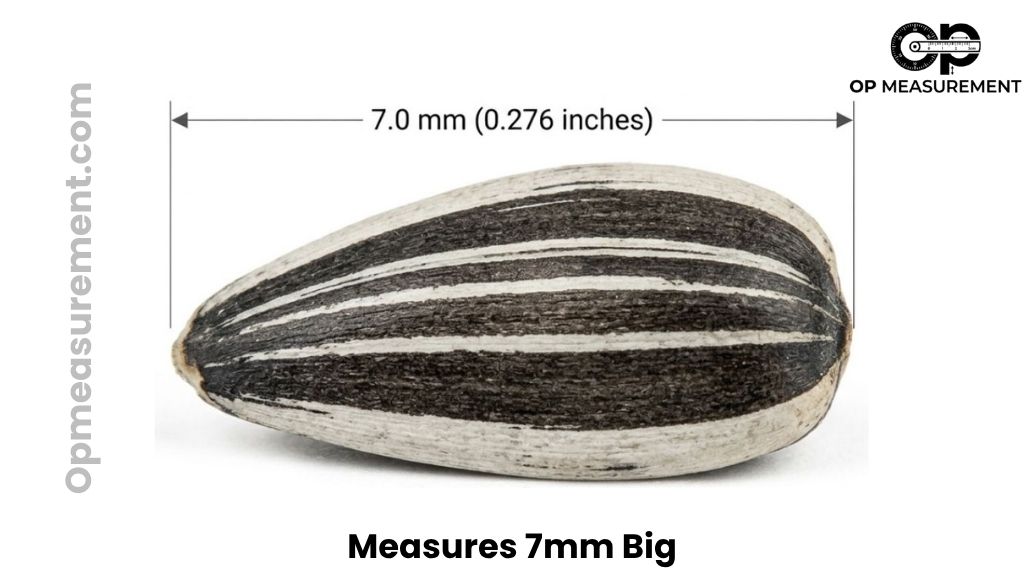
The striped sunflower seeds sold for snacking or bird feeding are larger than the black oil variety used for pressing oil. The width of a typical commercial striped sunflower seed, measured across its broadest point, falls roughly in the 7mm range. The length, however, is considerably greater, often running 12mm to 15mm.
Like the coffee bean, this comparison requires specifying the dimension. A sunflower seed is narrow across its width and long from tip to tip. When you orient one horizontally and measure the short axis, that width is where 7mm applies. It’s a natural example that most people can picture from memory, even without holding one in hand.

Vera loves exploring the size and dimensions of everyday objects. She shares practical, visual guides to help readers understand measurements clearly. With a focus on accuracy and usefulness, Vera creates content that informs, engages, and supports learning for all.


