1000 feet equals 12000 inches, exactly 304.8 meters, and 333.333 yards, rounded. The examples below are size comparisons, not universal dimensions. Check the stated product length and distinguish height, width, interior space, and overall length. Count steps only after measuring your own step length.
1,000 feet equals exactly 304.8 meters — taller than almost every building you’ve ever walked past. To put that in your body: if you stacked 174 average adult men head to foot, you’d just reach this height. That’s the scale we’re working with.
Most people picture it wrong. The brain shrinks it down to something manageable — a tall office building, maybe a long street. It’s neither. It sits in that strange zone where it’s too big to see all at once and too small to feel truly massive. That’s what makes it hard to grasp. So let’s ground it in things you can actually touch, walk, or recognize.
The 1,000 Feet Numbers First
| Unit | Value | What It Feels Like |
| Feet | 1,000 | Base unit |
| Meters | 304.8 | Taller than most city skylines |
| Centimeters | 30,480 | The length of 304 standard rulers end to end |
| Millimeters | 304,800 | Engineering precision scale |
| Yards | 333.33 | Just over a third of a kilometer walk |
| Kilometers | 0.3048 | Less than one-third of a km |
| Miles | 0.189 | Nearly one-fifth of a mile |
10 Everyday Things That Measure 1,000 Feet
| Object | Category | Dimension (Feet) |
| Box of Cat5e/Cat6 Network Cable (full spool) | Everyday Item | 1,000 ft (length) |
| Commercial Aluminum Foil Roll | Commercial Kitchen Supply | 1,000 ft (length) |
| Great Lakes Ore Freighter (“1,000-footer”) | Ship | 1,000 ft (length) |
| Utility Rope Spool | Industrial Equipment | 1,000 ft (length) |
| NHRA Top Fuel Drag Racing Track | Sports | 1,000 ft (race distance) |
| Three American Football Fields (approx.) | Sports | 1,080 ft (length) |
| Large Cruise Ship | Ship | 950–1,100 ft (length) |
| Eiffel Tower (original iron structure) | Landmark | 1,024 ft (height) |
| The Shard, London | Skyscraper | 1,016 ft (height) |
| Average Walking Distance (3 min 45 sec) | Everyday Distance | 1,000 ft (walking distance) |
1. Box of Cat5e / Cat6 Network Cable

That flat cardboard box an electrician pulls out of his van on installation day — the one labeled “1,000 FT” in orange lettering — contains exactly this distance in coiled ethernet cable. This isn’t a rounding choice. It’s a deliberate manufacturing standard so IT professionals and contractors can plan wiring runs across large floors without guessing how much cable remains.
Unroll that entire spool and it would stretch from one end of a city block to well past the next intersection. Network engineers mentally picture this distance every time they calculate cable runs for office buildings, hospitals, and data centers. The box itself is modest enough to carry under one arm. What’s inside it is not modest at all.
2. Commercial Aluminum Foil Roll

Not the box sitting in your kitchen drawer. The industrial kind — the heavy-duty dispenser boxes shipped to restaurant kitchens, hospital cafeterias, and hotel catering operations — contains a roll that runs exactly 1,000 feet long. These rolls are manufactured to this length because commercial kitchens consume foil at a rate home cooks never approach.
Stretched flat, that single roll could line roughly 2,500 full-size sheet pans. Kitchen staff often go through an entire spool in a few weeks. The length is purely functional — enough to last a busy kitchen through a meaningful stretch of service without constant restocking.
3. Great Lakes Ore Freighter

On the Great Lakes, “1,000-footers” is a real industry term — not a nickname, not an approximation. Ships like the Stewart J. Cort and Burns Harbor were engineered and built to exactly 1,000 feet in length to maximize cargo capacity while still fitting through the lock chambers of the Great Lakes waterway system. These vessels carry iron ore, coal, and limestone across the lakes in volumes that would take hundreds of trucks to move.
Standing on a dock next to one of these ships is a different experience entirely. The bow disappears into the distance before you’ve even processed the stern. The ship looks less like a vessel and more like a section of floating highway. Length here isn’t an aesthetic choice — it’s the precise upper limit the infrastructure allows.
4. Utility Rope Spool
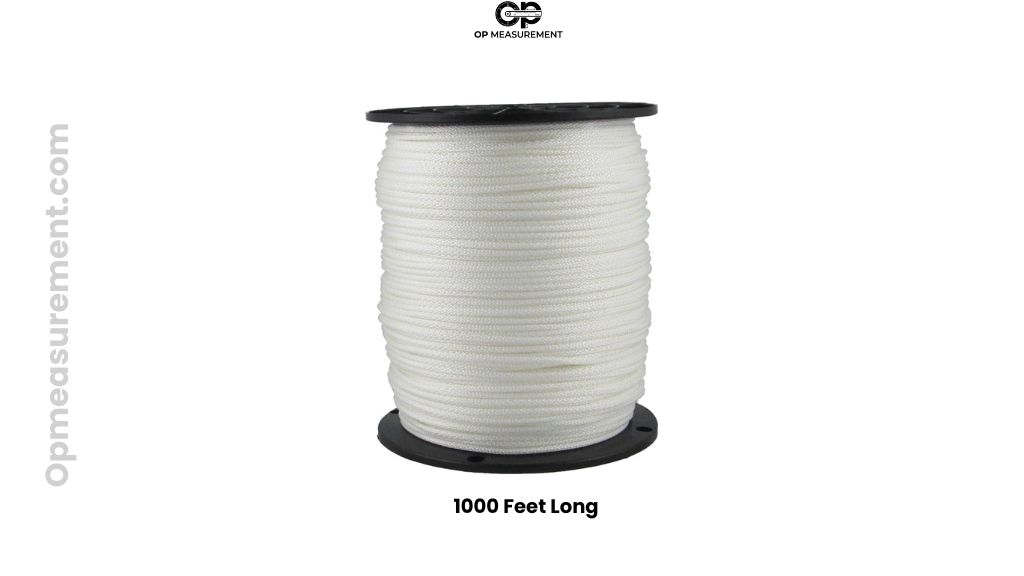
Walk into any industrial supply warehouse or marine hardware store and you’ll find utility rope — nylon, polyester, polypropylene — sold on spools marked 1,000 feet. Diameters range from 1/8 inch to 3/4 inch depending on load rating. Construction crews, dock workers, arborists, and rescue teams all buy rope by the spool because the math works cleanly at this length.
A full spool of 1/2-inch nylon rope at 1,000 feet weighs around 18 to 22 pounds depending on braid style. It sits comfortably on a standard rope holder or ground roller during deployment. When a rigger says “grab a spool,” this is the unit they mean.
5. Standard Drag Racing Track (1,000-Foot Class)

In 2008, NHRA — the National Hot Rod Association — officially shortened its top-fuel drag racing distance from the traditional quarter-mile (1,320 feet) to exactly 1,000 feet. The reason was safety. Modern top-fuel dragsters now reach speeds above 330 miles per hour, and the original track left too little room to slow down after the finish line. Trimming 320 feet off the race distance gave drivers the braking room physics demands at those speeds.
This makes 1,000 feet a live, active measurement in professional motorsport — not a historical footnote. Every time a top-fuel race runs, the distance is exactly this. Drivers cover it in under four seconds. The distance that takes a walking adult nearly four minutes passes beneath a dragster in roughly 3.7.
6. Three American Football Fields

One full NFL or NCAA football field — turf, both end zones, the whole thing — runs 360 feet from back line to back line. Three of those placed end to end equals 1,080 feet. So 1,000 feet falls right in the middle of that third field, about two-thirds of the way down the final stretch.
This comparison works because most people have stood on or near a football field at some point. You know how far the opposite end zone looks. You know the scale of that space. Now extend it twice more, stop two-thirds through the third repetition, and you’re standing exactly at 1,000 feet. That mental walk is useful.
Read more: How Long Is 50 Feet?
7. Cruise Ship End-to-End Span

Large ocean cruise ships don’t reach 1,000 feet in height — they’re built wide and low relative to their length. But their end-to-end span, from bow to stern, runs between 950 and 1,100 feet on most major modern vessels. The span of a typical large cruise ship is essentially a real-world ruler for this distance.
What makes this comparison stick is context. Passengers often walk the full length of the ship on deck and comment on how long it takes. A casual walk from the ship’s front railing to its rear takes several minutes. That slow, slightly breezy promenade deck walk is your physical experience of 1,000 feet — stretched out flat on water.
8. The Eiffel Tower (Near-Exact Match)

The Eiffel Tower’s original 300-meter height is about 984 feet, while its current total height including antennas is 330 meters, about 1,083 feet. These are nearby comparisons to 1,000 feet, not an exact match. The tower’s official height history explains the change.
This comparison works vertically, which changes how it feels entirely. Looking up at the Eiffel Tower from the base and knowing that 1,000 feet ends just short of the tip recalibrates your sense of the height. It stops being an abstract number and becomes a thing you can point to in a photograph.
9. The Shard, London

The Shard stands at 1,016 feet (309.6 meters), making it the tallest building in the United Kingdom and Western Europe. That means 1,000 feet in height would place you just below its glass apex — still above every surrounding rooftop in that part of London, with a view that covers nearly the entire city.
The interesting thing about The Shard as a reference is its shape. It tapers toward the top, so 1,000 feet up sits in the narrowing upper section where the floors are smallest. By that elevation, the building feels like a point rather than a floor plan. That visual thinning is a good mental image — 1,000 feet is where structures start to run out of room.
10. A Walk You Complete in Under Four Minutes
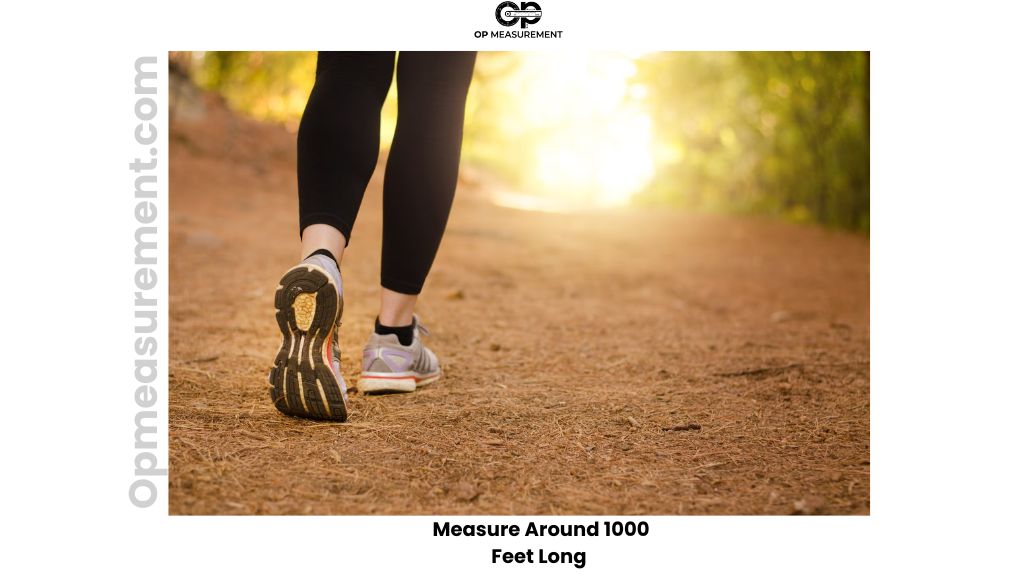
At a relaxed, normal walking speed of 3 miles per hour, a person covers exactly 1,000 feet in 3 minutes and 45 seconds. Not power-walking. Not jogging. Just a regular pace — the kind you’d use crossing a parking lot or moving between terminals at an airport.
This might be the most practically useful version of this measurement. When someone asks how far is 1,000 feet, the walking-time answer lands better than any unit conversion. It transforms distance into lived time. You’ve covered this span hundreds of times without naming it. Now you have the name.
Read also:
How to Estimate 1,000 Feet Without Any Tool
Count your steps. The average adult stride covers about 2.5 feet. Walk 400 steps at your normal pace and you’ll be within 5 to 8 percent of 1,000 feet. Good enough for marking off a space, estimating a lot size, or checking a property boundary in the field.
Use your car’s odometer. One mile equals 5,280 feet. Watch for your odometer to move 0.19 miles and you’ve traveled roughly 1,000 feet. Works well on flat roads where you need to measure a distance quickly without stopping.
Count city blocks. In most American cities, blocks run between 250 and 400 feet depending on local grid design. Manhattan’s east-west blocks average around 250 feet, so four of those gets you close. Longer suburban blocks may only need two or three. Know your local grid and this method gets surprisingly accurate.
Common Measuring Mistakes
Confusing vertical and horizontal. 1,000 feet tall and 1,000 feet long are the same number but completely different experiences. A building at this height is extraordinary. A road at this length takes under four minutes to walk. Don’t apply the wrong mental frame.
Swapping feet and meters. 1,000 meters equals 3,281 feet — more than three times larger than 1,000 feet. This mix-up happens often in international construction and engineering contexts where unit systems cross. A structure described as “1,000 meters” is not a near match for the Eiffel Tower. It would be the tallest thing ever built by a wide margin.
Assuming it’s a short distance. People consistently underestimate this span. It covers nearly two city blocks in most grids, spans a full professional sports field with room left over, and takes the average person nearly four full minutes to walk. The instinct to shrink it is reliable — and reliably wrong.
Using This Measurement
1,000 feet sits in an interesting middle ground. Too tall to casually glance up at. Too short to see from across a city. Big enough to hold a Great Lakes freighter, a drag racing track, or the iron frame of the Eiffel Tower — yet small enough to walk in under four minutes.
Numbers this size tend to feel abstract until you tie them to something you’ve already seen or touched. A spool of rope on a job site. The ethernet cable box in a server room. Three football fields stretching out ahead of you on a flat afternoon.
Once one of those images locks in, the distance stops being a number and starts being a place you can picture yourself standing.
For another size reference, see How Far Is 500 Feet?
Conversion reference: NIST unit definitions and conversion factors. Rounded values are for comparison; product dimensions and weights should be checked against the specific item.

Vera loves exploring the size and dimensions of everyday objects. She shares practical, visual guides to help readers understand measurements clearly. With a focus on accuracy and usefulness, Vera creates content that informs, engages, and supports learning for all.