200 feet equals 2400 inches, exactly 60.96 meters, and 66.667 yards, rounded. The examples below are size comparisons, not universal dimensions. Check the stated product length and distinguish height, width, interior space, and overall length. Count steps only after measuring your own step length.
200 feet equals 60.96 meters — almost exactly the length of an NHL ice hockey rink from one end board to the other. Walk it in a straight line at a normal pace and you’ll be done in about 45 seconds. Sounds short. It isn’t.
Most people picture 200 feet and shrink it in their heads. Then they stand at one end of an empty parking lot, look toward a marker 200 feet away, and think — oh. That’s actually out there.
The 200 Feet Numbers at a Glance
| Unit | Value | Real-World Feel |
| Feet | 200 ft | One full NHL rink, end to end |
| Meters | 60.96 m | Just over half a standard soccer field |
| Centimeters | 6,096 cm | About 86 school rulers laid flat |
| Yards | 66.67 yd | Two-thirds of a football field |
| Miles | 0.0379 mi | Walk it 26 times to make one mile |
| Kilometers | 0.061 km | A very short jog |
What 200 Feet Actually Feels Like to Walk
Your average walking pace covers about 4.5 feet per second. Do the math and 200 feet takes roughly 44 seconds on flat ground. That’s the distance from a grocery store’s back wall to the front checkout lanes. It’s how far you walk from a parking spot to a restaurant entrance on a Saturday night.
You do this distance constantly — you just never count it.
At a light jog (around 8 feet per second), you clear it in about 25 seconds. A sprinter at full speed covers it in roughly 10.
200 Feet on a Football Field
Start in one end zone and walk toward the opposite end. At 200 feet, you’re standing at the opponent’s 33-yard line — about two-thirds of the way down the playing field. You’ve passed the midfield mark. The far end zone is still 34 yards away.
On a soccer pitch, 200 feet puts you just past center, slightly into the opposing half. You’re not near the goal yet.
How Tall Is 200 Feet? (The Human Scale)
The average adult stands around 5.7 feet. Stack 35 of them and you’ve got 200 feet. That’s a 20-story building. The Statue of Liberty from her base to torch tip is 305 feet total, but her copper figure alone stands 151 feet — meaning 200 feet clears Lady Liberty’s crown by about 49 feet.
Stand at the base of a 20-story downtown office building, tilt your head back, and look up. That roof edge above you? That’s your 200-foot vertical.
Daily-Use Things That Are 200 Feet Long
| Object Category | Dimension | Real-World Reference |
|---|---|---|
| NHL Hockey Rink | 200 feet | End board to end board |
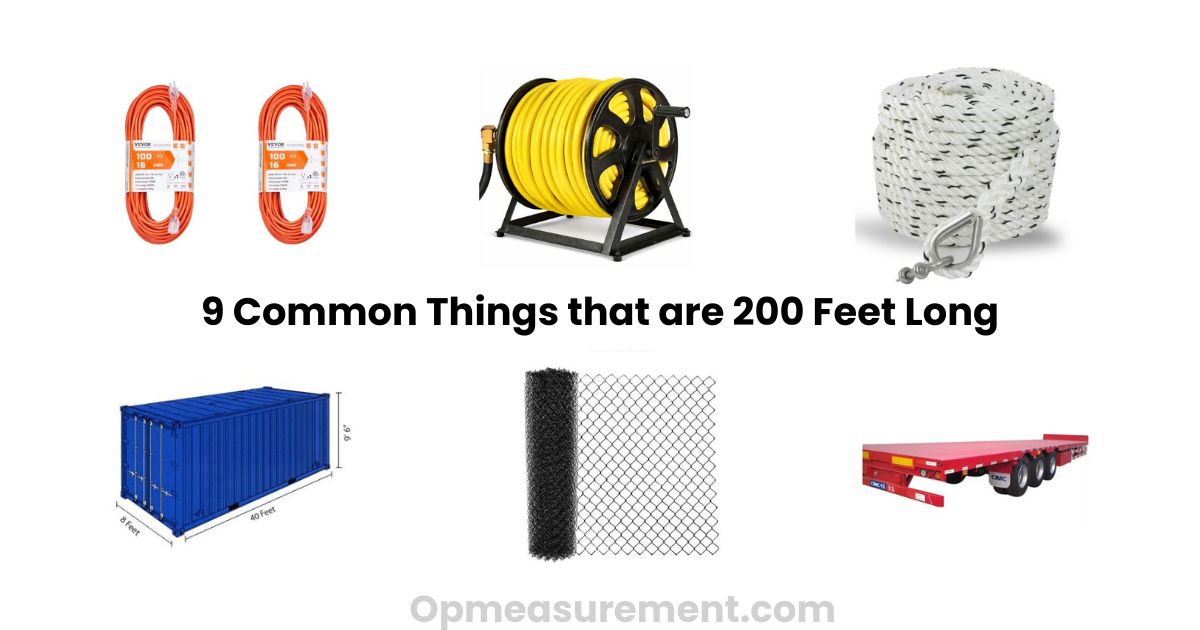
| Garden Hose | 200 feet | Long outdoor watering reach |
| Surveyor’s Tape Measure | 200 feet | Professional measuring tool length |
| Extension Cords (Two 100-Foot Cords) | 200 feet | Combined length |
| Shipping Containers (Five Containers) | 200 feet | Five 40-foot containers in a row |
| Semi-Truck Trailers (Four Trailers) | 200 feet | Four trailers placed together |
| Chain-Link Fence Roll | 200 feet | Commercial fencing length |
| Outdoor String Lights | 200 feet | Large outdoor setup length |
| Mooring Line | 200 feet | Commercial dock rope length |
Garden Hose — 200 Feet of Reach
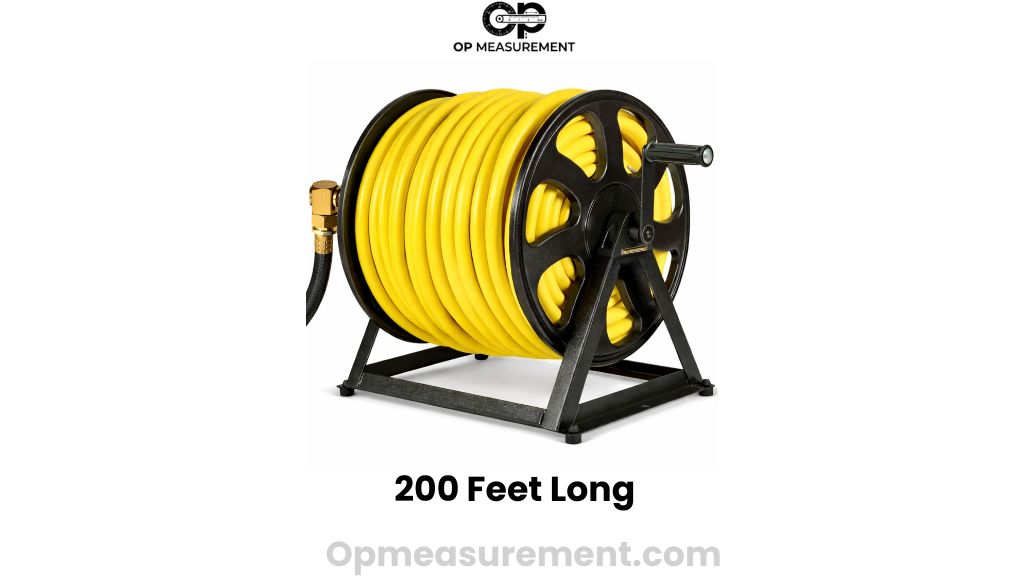
A 200-foot garden hose sounds excessive until you have a large backyard, a side yard, and a vegetable patch that all need watering without moving the spigot. These are sold at most large hardware stores — no special order needed. You’ll find them in traditional rubber, stainless steel coil, and lightweight expandable versions.
The practical advantage is obvious once you’ve dragged a 50-footer across a property and still come up short. A 200-foot hose reaches the far corner of most residential lots without you needing to reposition anything. Roll it onto a wall-mounted reel and it stores neatly against the house.
Open-Reel Surveyor’s Tape Measure
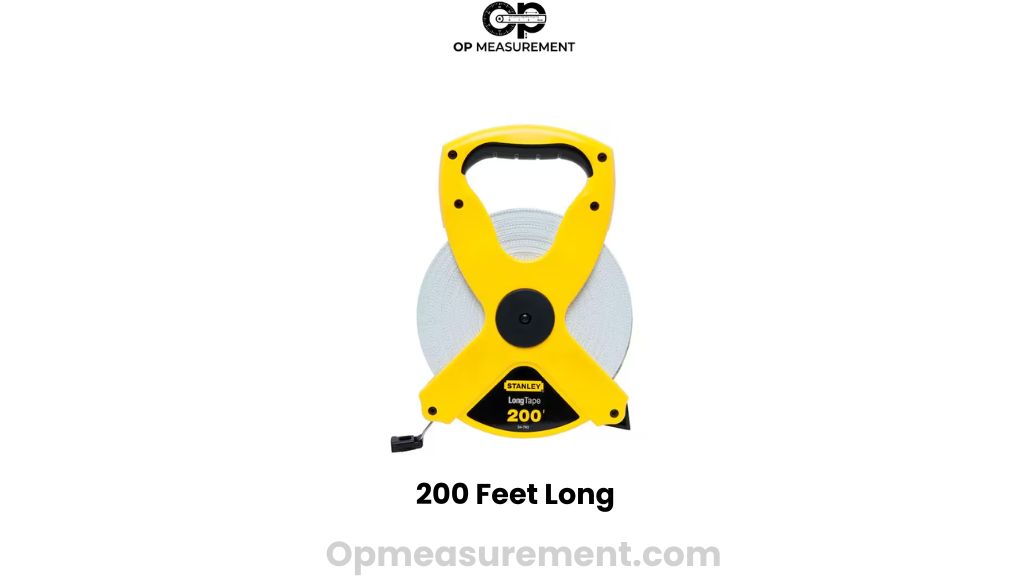
Surveyors and professional landscapers carry these on large jobs. The tape sits coiled inside a bright orange or yellow housing and unwinds like a giant fishing reel — all the way out to 200 feet of calibrated steel. When you see one of these stretched across a construction site or laid flat across a field, you’re looking at one of the most precise physical references for this distance that exists.
Landscapers use them to mark property lines, set fence posts, and plan irrigation runs. The fact that this tool was built specifically for this range tells you something: 200 feet is a real, practical working distance in outdoor projects — not just a number.
Two 100-Foot Extension Cords, End-to-End
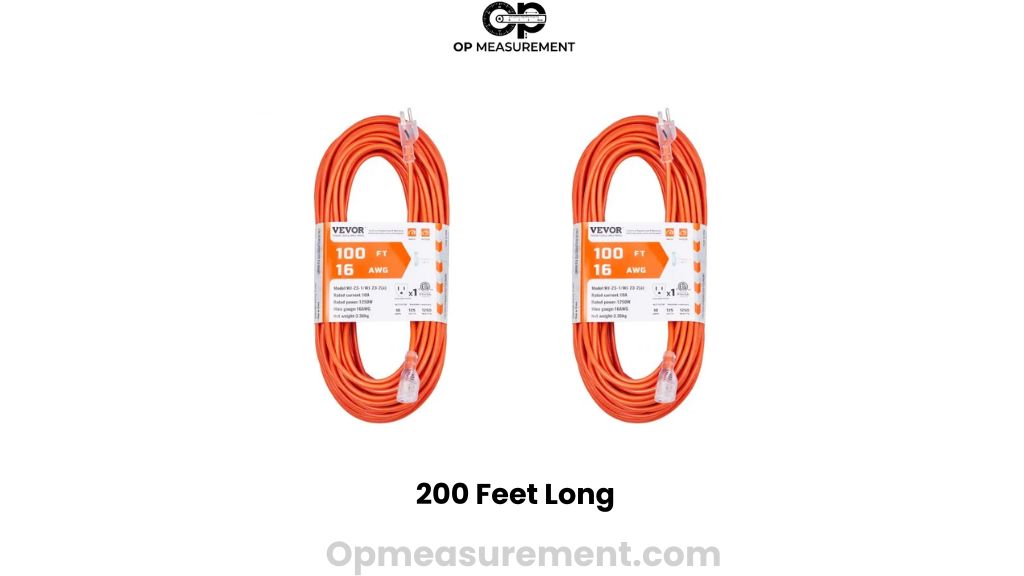
This surprises people. Standard heavy-duty outdoor extension cords are commonly sold in 100-foot lengths at hardware stores. Plug two together and you’ve got an exact 200-foot run. Electricians and contractors do this on large outdoor sites constantly when a single cord won’t reach a power source.
The combined weight of two heavy 100-foot cords is significant — you’ll feel the drag when you pull them across a yard. That physical resistance is actually a good reminder of how much wire is stretched out between you and the outlet.
Five Shipping Containers in a Row
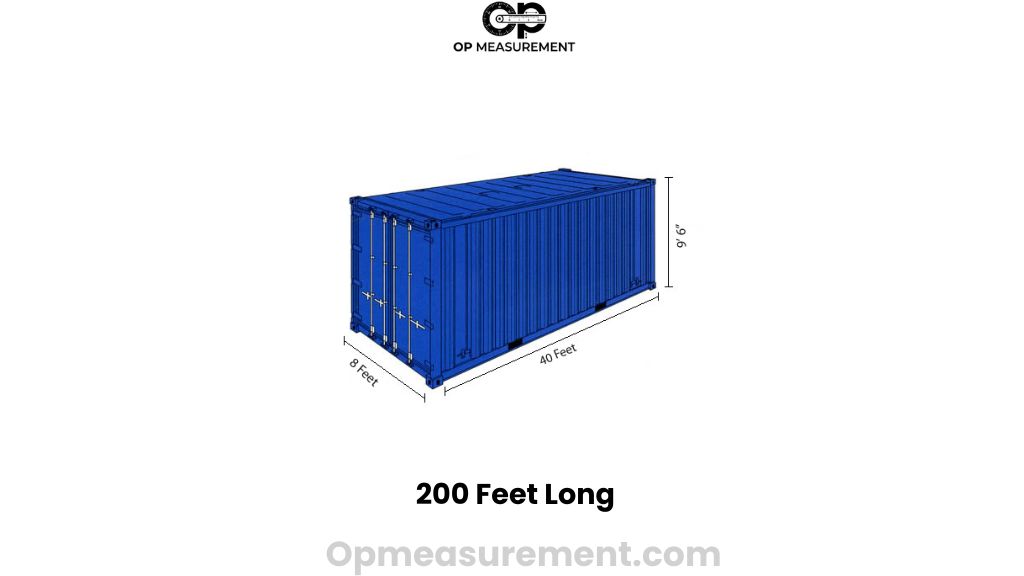
One standard intermodal shipping container — the kind stacked on cargo ships and hauled by freight trains — measures exactly 40 feet long. Five of them placed end-to-end reach 200 feet. That’s a wall of steel roughly two-thirds the length of a city block.
Port facilities and large warehousing operations actually use this as a rough spatial planning reference. If you’ve ever stood near a container yard and watched them stack and arrange those massive steel boxes, counting five in a straight line gives you an instant ground-level sense of 200 feet.
Four Semi-Truck Trailers, Bumper-to-Bumper
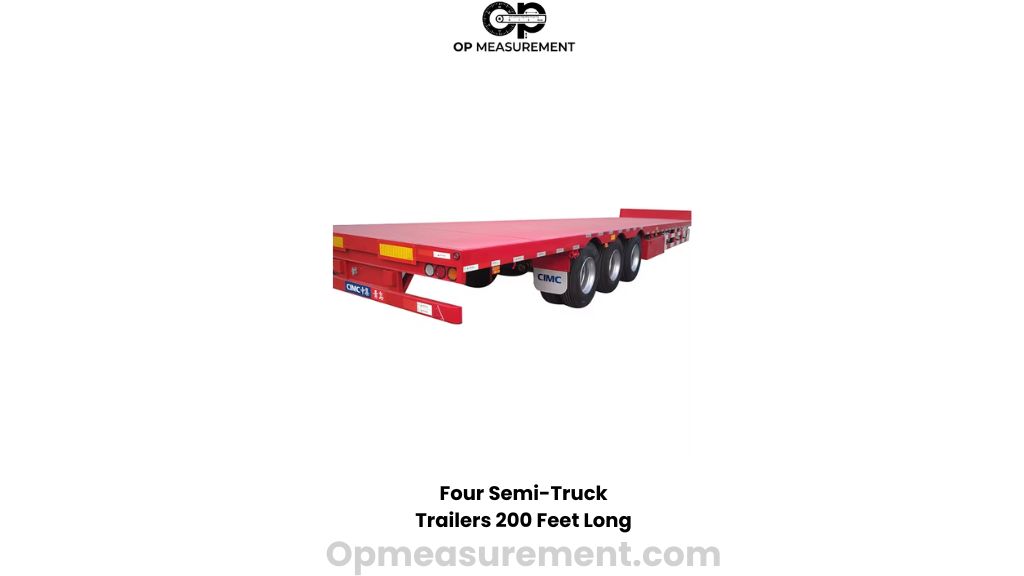
Standard dry-van semi trailers run 48 to 53 feet in length. Four of them parked tightly together — cabs removed — land you right at 200 feet of trailer. Next time a convoy passes you on the highway, count four trailers in sequence and watch them pass. That scroll of aluminum and steel rolling by is 200 feet moving at highway speed.
It passes faster than you’d expect. Which, again, is the thing about 200 feet — it reads as less than it is.
Read more: How Far Is 500 Feet?
Commercial Chain-Link Fencing Roll
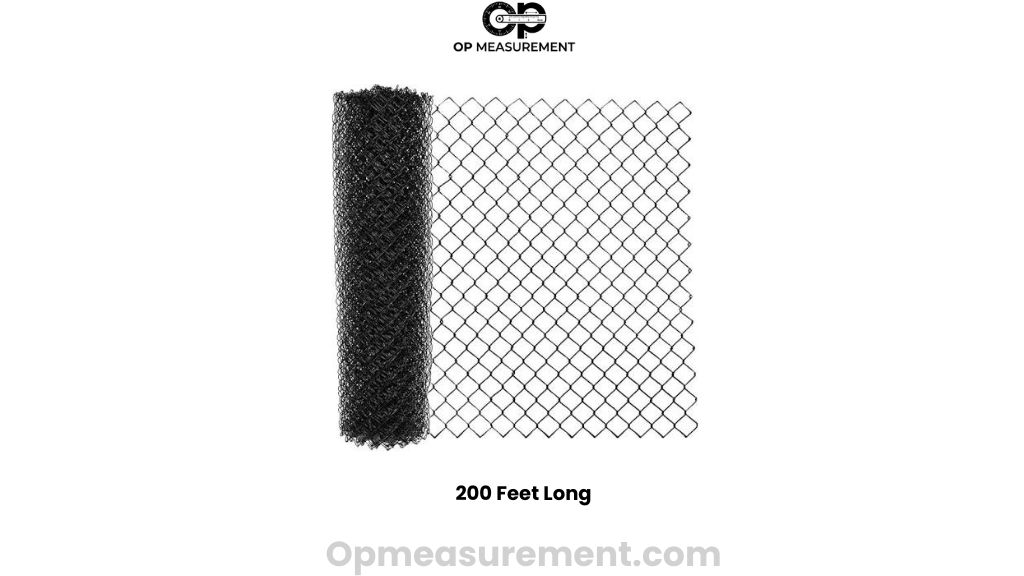
Industrial chain-link fabric for large commercial fencing jobs is manufactured and shipped in 200-foot rolls as a standard length. A landscaper ordering fencing for a commercial property site will often specify these as their base unit — one roll, 200 feet of continuous fabric, wound tightly on a heavy spool that takes two people to load off a truck.
If you’ve ever watched a fence crew unroll one of these across a yard, you get a real sense of the span. They don’t stop unrolling for a while.
Outdoor Patio String Lights — 200-Foot Strand

Commercial bistro-style string lights for restaurant patios, outdoor event venues, and large backyard setups are regularly sold as single 200-foot continuous strands. String one from one end of a large outdoor space to the other and you’ll quickly see that 200 feet of lights covers an enormous area — far more than most homeowners picture when they order them.
Event planners use these as a measuring instinct: if you can run one continuous strand without splicing, the space fits within 200 feet. If you need two strands, you’ve exceeded it.
Maritime Mooring Line
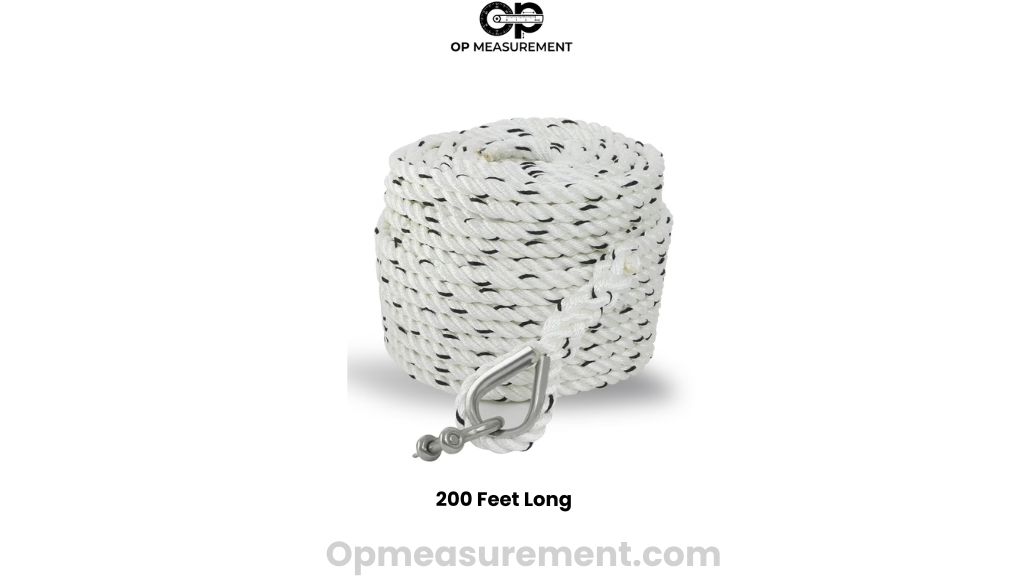
On commercial docks and working marinas, standard braided nylon mooring ropes for mid-sized boats and commercial vessels are regularly pre-cut and sold at 200-foot lengths. These ropes are thick, heavy, and rated for serious load. A 200-foot mooring line coiled on a dock looks deceptively small — but stretch it across a parking lot and you realize how far that coil actually reaches.
This is one of those cases where the same distance feels completely different depending on its form. Coiled, 200 feet seems compact. Stretched flat, it feels like a long road.
Read more:
Measuring 200 Feet Without Any Tools
Pace counting is the oldest method. Most adults cover about 2.5 feet per walking step. Count 80 natural steps from a fixed starting point and you’re within a few feet of 200. To get accurate for your specific stride, measure 10 feet indoors first, count your steps, then scale up.
A phone map can provide a rough outdoor estimate, but GPS accuracy varies with buildings, trees, signal conditions, and the device. Do not rely on it for property boundaries or precise layout work; use a tape or surveying equipment.
Car reference — a tenth of a mile on your odometer equals 528 feet. So 200 feet is a little under 40% of that first tick. In a large parking lot, drive slowly and stop well before the odometer clicks — you’ll be near 200 feet.
How Far Is 200 Feet in Blocks and Miles?
In most American cities, a standard block runs 300 to 600 feet depending on the city grid. Using Manhattan’s avenue blocks as a reference (about 264 feet), 200 feet is roughly three-quarters of one block. You’d reach the corner and still have about 60 feet left to walk.
In miles, 200 feet is 0.0379 miles — or about 1/26th of a mile. A 5K race is 16,404 feet, which means 200 feet covers just over 1% of it.
Two Mistakes People Keep Making
Mixing up feet and meters. They’re close enough to cause real confusion. A 60-meter swimming pool is about 197 feet — nearly identical to 200 feet. But a 60-foot pool is only 18 meters, roughly a third the size. The numbers look similar; the actual spaces are drastically different.
Underestimating the distance in open areas. Without nearby reference objects — buildings, fences, cars — your brain compresses distance. 200 feet in an open field looks like 100 feet. This happens to nearly everyone. When no objects break up the space, the eye has nothing to anchor scale. Walk it before you assume it’s closer than it looks.
Using This Measurement
200 feet is one of those distances that lives in a strange middle ground — too far to casually toss something, too short to feel significant on a map. But once you tie it to something real — five buses, a hockey rink, a fully unrolled surveyor’s tape — it stops being a number and starts being a place you can picture.
That mental image matters more than the conversion table. Numbers fade. Visuals stick.
Next time someone mentions 200 feet in a blueprint, a property listing, a safety clearance, or a zoning notice, you won’t need to pause and calculate. You’ll already know exactly what you’re working with — and how far you’d have to walk to cross it.
For another size reference, see How Far Is 100 Feet?
Conversion reference: NIST unit definitions and conversion factors. Rounded values are for comparison; product dimensions and weights should be checked against the specific item.

Vera loves exploring the size and dimensions of everyday objects. She shares practical, visual guides to help readers understand measurements clearly. With a focus on accuracy and usefulness, Vera creates content that informs, engages, and supports learning for all.