Ask suppliers where football uniform design goes wrong most often, and the answer is rarely the colours or the crest. It is sizing: uniforms measured on the player’s body, then expected to fit over hard shoulder pads.
The mistake usually surfaces in week one. Jerseys arrive, half the line cannot get their arms down, and the fix is a rushed second order at worse prices and awkward minimums.
This guide works through the whole order: sizing over pads, the number rules leagues already enforce, print methods, budgeting for a second set, and reorders. Get these right and week one is quiet.
Size the pads, then the player
Football is the one sport where the uniform goes over hard equipment, and that changes everything about fit. A jersey that fits in the locker room can become a straitjacket over pads.
The working rule most equipment managers use is to size up one from a player’s normal shirt size for skill positions, and two for linemen in full shoulder pads. Better still, measure chest circumference over the pads.
Too loose fails as well. Baggy fabric gives a defender something to grab, and some leagues will flag it. The target is snug over the pads, with no loose material hanging at the sides.
The number rules your league already has and you haven’t read
Most youth and high school associations follow NFHS-style rules on numbering, and the specifics catch people out. Three checks cover most of them.
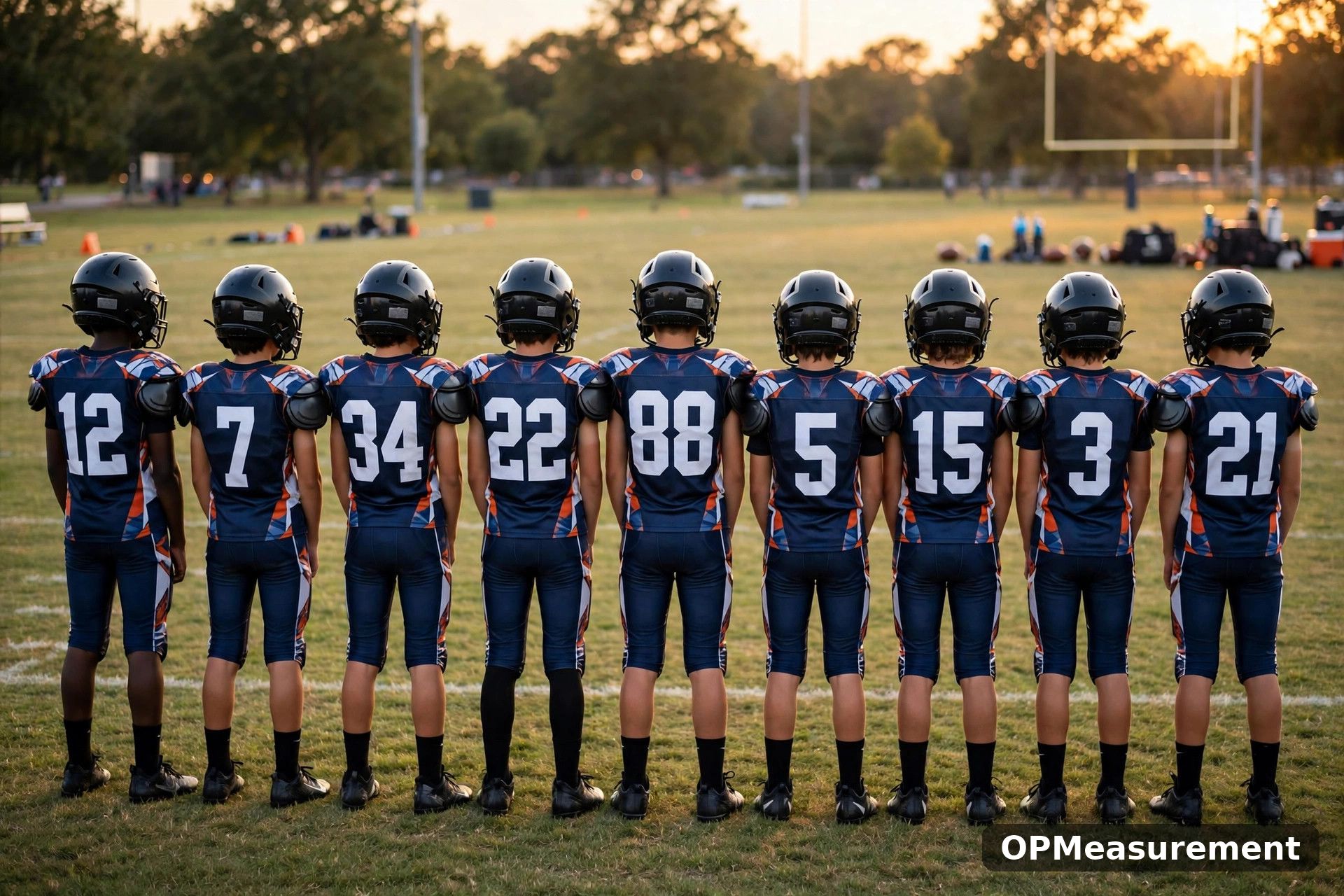
- Numbers must appear on the front and back, at a minimum height your league sets — commonly around 8 inches on the front and 10 inches on the back at higher levels.
- The number colour has to contrast clearly with the body of the jersey, so it stays readable at distance.
- Duplicate numbers on the same team are usually prohibited, even across offence and defence.
Confirm the details against the official football numbering rules before you approve artwork, not after. Suppliers print what you send them.
Sublimation is the reason your numbers stop peeling
Older jerseys used screen-printed or sewn twill numbers. Twill looks sharp and lasts, but it adds weight and cost. Screen print is cheaper, and it cracks — often down the middle of a number by mid-season.
Sublimation dyes the graphic into the polyester fibres instead of layering ink on top, so there is nothing to peel away. It also allows full-bleed patterns and gradients across the whole panel — the process behind how dye sublimation printing works explains why.
The trade-off is fabric. Sublimation works properly only on polyester, so cotton-feel practice shirts need a different print method, and a different quote.
Budget for the second set before you buy the first
Football is brutal on fabric: turf burns, grass stains, tape residue and forty washes a season. A single set takes all of that punishment with no rotation and no rest.
Programs that buy only home jerseys end up washing between games on short weeks, and hot washing and drying degrade fabric quickly. Two sets spread the wear, which is why they commonly last around twice as many seasons.
Per-unit prices fall as quantities rise, so pricing both sets in one order usually beats two separate orders. Ask for the two-set figure before approving the one-set figure, and use a team uniform budget breakdown to show the maths.
Reorders are where minimums hurt
A player transfers in. A jersey gets shredded. A grandparent wants a replica. Mid-season needs arrive one jersey at a time, and they do not care about your supplier’s minimum order.
Suppliers with a ten or twelve-piece minimum cannot help with a single jersey, so you wait until next season or buy twelve. Before committing, ask one question: what is your process for a single mid-season replacement, and what does it cost?
Also ask whether they keep your design on file. If they do, a reorder is a two-minute email. If they do not, you are rebuilding artwork from scratch and hoping the colours match.
The order I’d place
For a youth or club program: single-layer sublimated jerseys sized over pads, numbers in a block font at league-legal height, and numbers ordered in a non-sequential range so replacements slot in later.
Order from a supplier with no minimum and published pricing, so a replacement costs what the first jersey cost. Skip the metallic accents: they cost more, photograph as grey, and date the design within two seasons.
A Pre-Order Checklist That Catches the Mistake Early
Five checks, done before the deposit, prevent almost every week-one problem.
- Measure every player wearing full pads, not street clothes.
- Check number height, contrast and duplicates against the league rule sheet.
- Match the print method to the fabric you are actually buying.
- Price two sets together before approving a single set.
- Get the single-replacement process and the design-on-file answer in writing.
Home and Away: Planning Both Colour Sets
Treat the second set as a contrast tool, not just a spare. A light set and a dark set between them cover almost every opponent’s colours and keep your team readable in any matchup.
Check number legibility on both sets, not just the home one. A number colour that stands out on a dark jersey can disappear on a light one, and officials judge each set on its own.
Frequently Asked Questions
How much bigger should a jersey be over shoulder pads?
One size up from normal for skill positions and two for linemen is the common working rule. Measuring chest circumference over the pads is more reliable than any rule of thumb.
Can you sublimate a design onto cotton?
No. Sublimation bonds with polyester fibres, so cotton shirts need screen print, vinyl or another method. Most modern game jerseys are polyester for this reason.
Why do printed numbers crack during the season?
Screen print sits on the surface of the fabric, so repeated stretching, washing and contact split the ink layer. Sublimated numbers are dyed into the fibres and cannot crack in the same way.
How long should a set of football uniforms last?
It depends on washes and rotation. Programs commonly find a two-set rotation lasts around four seasons where a single set lasts around two, because each jersey is worn and washed half as often.
Conclusion
The most common football uniform mistake is not artistic at all. It is measuring the player instead of the pads, and discovering the difference in week one.
Size over pads, check the number rules, sublimate on polyester, budget for the second set and protect yourself on reorders. Do those five things and the design can finally be the fun part.